Conflicts,
populism & extremism
Awards
Council of Europe Nomination for Democracy Innovations Award 2022
Why do people radicalise? (Video)
How do most people cope with individual and social challenges & changes?
The General MOSAIC Framework:
Meaning Oriented Social And Individual Changes
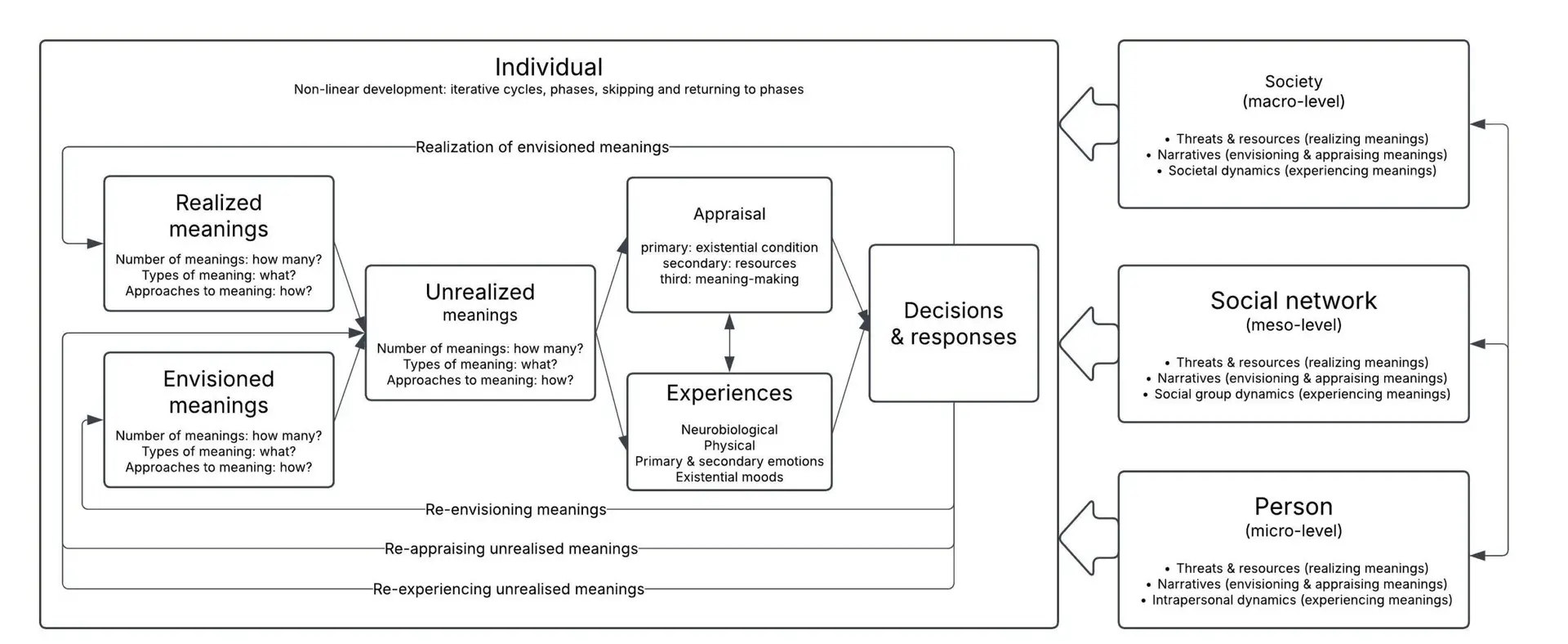
Responses & decisions to individual or social challenges & changes in life
When we can no longer realise the meaningful life we had envisioned, we generally have four responses and decisions:
1. Envision meanings
Change the meaningful life we envision
Examples: when we become unemployed, we may focus less on work and more on family
2. Realise meanings
Change the methods and strategies how we realise the meaningful life we envision
Examples: when we become unemployed, we may search for a job in a new sector, or decide not to work again
3. Appraise unrealised meanings
Change how we evaluate the threats/limitations, resources/opportunities, and meaning-making attempts
Examples: when we become unemployed, we may accept or suppress our frustrations, or turn these into public anger
4. Experience unrealised meanings
Change our neurobiological, physical, emotional, and existential responses
Examples: when we become unemployed, we may blame ourselves, our former employer, politicians, or minority groups
Social influences on our responses and decisions about meaning in life
Our responses and decisions about meaning in life are influenced by:
A. Society (macro-level)
· Society's realistic threats/limitations & resources/opportunities: Our society may offer various resources/opportunities and threats/limitations to realise the meaningful life and world we envision
· Society's narratives: Socioeconomic and political powers and trends in society influence how we envision a meaningful life and world
· Society's social dynamics: Our unique position in society influence our unique threats/limitations & resources/opportunities, and influential societal narratives.
Examples: politicians, education system, national economics, media, propaganda
B. Social network (meso-level)
· Threats/limitations & resources/opportunities: how we realise meanings in our network
· Narratives: how we envision meanings & appraise unrealised meanings in our network
· Social dynamics: how we experience meanigs in our network
Examples: political group, social media group, church, neighbourhood, school, community leaders, peer pressure
C. Personal life situation (micro-level)
· Threats/limitations & resources/opportunities: how we realise meanings in our life
· Narratives: how we envision meanings & appraise unrealised meanings in our life
· Social dynamics: how we experience meanings in our life
Examples: personal life experiences, upbringing, early life messages
An example of the MOSAIC Framework:
The manosphere is an extreme attempt
for existentially desperate men to find meaning in their manhood,
as they cannot realise the meaningful life they want
in our all-too-often challenging society
that they see as personally threatening and limiting their opportunities.

An example of the MOSAIC Framework:
Gangs appeal to young people who cannot live a meaningful life in our challenging world.
Where adults have created an all-too-often threatening world that offers few other resources to live a meaningful life, the appeal of gangs is not the fault of young people.
Instead, gangs step in to offer all types of meaning, supplying wealth, fun, excitement, identity, belonging, values & culture.
How do populists manipulate people’s meaning-making?
The General MOSAIC Framework of Populism:
Meaning Oriented Social And Individual Changes

Populists put salt in the wounds of our unrealised meanings in life and then tell us to buy their pain killers.
Populists are meaning manipulators
1. Populists make us focus on our unrealised meanings
A. They tell our envisioned meanings are valid and realistic
B. They confirm we have tried everything to realise our meanings
C. They make us focus on all the meanings we have not realised, even unrealistic ones
D. They make us shift from theory to our lived experiences, such as our physical experiences, emotions and existential anxieties
Examples: Populists can always find reasons to get supporters, as it is unrealistic to expect from life that we can realise all the meanings we envision. Populists give much space to their followers to express their frustrations, anger, and exhaustion over the failure to achieve 'the simple dreams of ordinary people', for example on social media, in interviewes, and political rallies. They may create self-reinforcing emotional echo-chambers as their followers validate each of other, and remind/inspire each other of frustrations they may not have considered before. Initially, populists may focus on unrealised materialistic, hedonistic and self-oriented types of meaning, such as housing problems, unemployment, lifestyle, health, autonomy, and self-expression; focusing on such unfulfilled superficial types of meaning could make their followers search for other ways to live a meaningful life, including searching for social and abstract types of meaning in the populist ideology and social movement. Populists particularly target individuals who have unrealistically high expectations about their life and world, have failed many meaning-making attempts, face some social threats and lack resources, and struggle to regulate their emotions (yes, you should check again the components of the before-mentioned MOSAIC Framework, as these evidence-based characteristics of populism-vulnerable individuals empirically align with this framework).
2. Populists offer unrealistic appraisals of our unrealised meanings
A. Radical primary appraisal: Populists exaggerate the external threats and limitations to the meaningful life and world we envision.
B. Radical secondary appraisal: Populists exaggerate our lack of resources and opportunities to realise our meanings in life.
C. Radical tertiary appraisal: Populists exaggerate our failed attempts to realise the meaningful life and world we want
Examples: People are more likely to interpret their unrealised meanings not merely rationally or theoretically, but also with strong emotions, and with strong physical, neurobiological and existential responses, if they believe, or are made to believe, that their frustrated meanings, such as unemployment, are not merely a one-off incident or bad lack, but are caused by structural external threats, such as one or more powerful "enemies" who intentionally or unintentionally prevented them from living the meaningful life they wanted (e.g., unemployment due to the bad intentions and/or practices of an "evil" employer, politicians, immigrants, or other "threatening" groups of individuals). Populists often exaggerate the risks to their followers' personal and collective survival, and remind them of their mortality. For example, they may frame the unrealised meanings as increasing their risk of death, such as being unable to pay for their food or housing, war or destruction of their country; such reminders of our mortality could make us bypass our critical reasoning, and commit to finding a more radical solution.
3. Populists make us re-envision our meanings
A. Populists make us prioritise the social and abstract types of meaning of their populist movement and ideology
B. Populists make us prioritise a small number of meanings in life
Examples: We are more likely to passionately commit and defend our meanings if we have no alternatives that can give us a sense of meaning and a reason to live with fewer efforts. Therefore, populists underline that their followers have very few meanings in life, or they make them give up some of them, such as by making them break with friends and relatives they frame as “unhelpful and not your real friend”. Instead, populists stimulate their followers to prioritise their involvement in the movement. They tell individuals to prioritise their social involvement in the populist movement and its ideals. Research shows that such social and abstract types of meaning are more fulfilling than materialistic, hedonistic and self-oriented types of meaning. For example, populists may tell their followers that they will not be able to live meaningful lives as long as the common threat has not been stopped. Therefore, their followers must be fully committed to the populist cause to stop this threat.
4. Populists offer methods and strategies to realise our envisioned meanings
Populists offer new methods and strategies to realise our meanings in life:
A. Populists promise new methods and strategies to realise a meaningful life
B. Followers get immediate meaning from involvement in the populist movement.
C. Populists become immune for criticism, thanks to: (1) their focus on social and abstract types of meaning may not require practical changes, (2) they may appraise failures by attributing these to external enemies or to internal enemies such as followers who are allegedly not committed or pure enough in their beliefs and actions.
Examples: A populist movement may offer its followers resources/opportunities for all types of meaning, such as: practical tools, and a sense of success and status (materialistic type of meaning), fun, excitement, and a lifestyle (hedonistic meaning), validation, self-acceptance, pride, perseverance, self-expression, skills training, and a sense of self-care (self-oriented meaning), social connections, sense of belonging, helping others, looking after others (social meaning), specific purpose and goal, connecting with ideals and humanity beyond themselves, sense of their unique place in history and humanity, values, ethics, trying to make the world a better place, spirituality or religion (large meaning), and abstract values such as their uniqueness, responsibility, and freedom (existential-philosophical meaning). Usually, populists focus mainly on social and abstract types of meaning, as these are often more likely to be achieved, as they do not require practical changes, such as populists may (implicitly) say, “Our enemy tries to stop us from living a meaningful life, but we can still find meaning in our pride, common identity, perseverance, values and beliefs.” As soon as populists gain actual political and/or economic power, they are likely to lose supporters, as they may not deliver on their practical promises, and they have primed and over-sensitised their followers to focus on their unrealised meanings and frustrations.
Simple political meanings start to appeal to people who have repeatedly failed to live a meaningful lifein a complex context.
Conspiracy beliefs & voting for populists are predicted by the existential anxiety, that is caused by many failed attempts to live a meaningful life.
(After: Van der Nest & Vos, 2025)
How do extremists and terrorists make meaning?
The MOSAIC Framework of Extremism and Terrorism:
Meaning Oriented Social And Individual Changes
General definitions
Radicalisation
· Radicalisation is the process by which an individual becomes more radical or extreme in how their meaning-making and actions.
· 'Radicalisation' can be pro-democracy and non-violent, such as WWII Resistance Fighters. However, the term is usually used to describe the process towards violent extremism and terrorism, such as 9/11 terrorists.
Example: The term 'radicalisation' is derived from the Latin word "radix", root. In antropomorphic terms, radicalisation implies changes, not merely at the surface (like the leaves of a plant), but at a person's roots: (a) how they envision a meaningful life and world (e.g., a plant 'wants' to survive and thrive), (b) the methods and strategies they use to realise this (e.g., a plant grows in the direction of sun and food), (c) how they experience and respond to meanings they cannot realise (e.g., encountering a lack of food or shadow due to other plants around), (d) how they appraise the threats/limitations, resources/opportunities, and their meaning-making attempts (e.g., perceiving other plants as an enemy or collaborator). In response to challenges and changes in their context, a plant can change at the root, reflecting changes in their 'appraisal' of the context (e.g., other plants are no longer collaborators but enemies), their experience of the contextual challenges and changes (e.g., hanging or dying leaves), the goals they 'envision' (e.g., short-term survival instead of flourishing), and the strategies and methods to realise these (e.g., aggressive towards other plants, e.g. spreading toxic allochemicals).
Extremism
· 'Extremism' refers to vocal or active opposition to core democratic values, including democracy, the rule of law, individual liberty, and mutual respect and tolerance of different faiths and beliefs.
· 'Extremism' does not need to be violent, but can be. The terms 'violent extremism' and 'terrorism' are often used together or exchangeably.
Example: The term 'extremism' comes from 'extremus', referring to an ultimate point. Extremism is the ultimate radical point of a person's meaning-making attempts. Historically, the term does not refer to anti-democratic values, but the term is nowadays mainly anti-democratic.
Terrorism
· 'Terrorism' refers to the use of violence or threat as a tactic to intimidate, with the intention to provoke a response from the broader public, such as intense anxiety and hypervigilance, which could lead to compliance to the terrorists' demands.
· We need to critical of how the terms are used, and who uses the terms. For example, authoritarian leaders may call their opposition 'extremist' and 'terrorist', even though this opposition may be democratic and non-violent opposition (Orwellian Double-Speak). For example, fascist leaders may label anti-fascists fascists.
Example: The term 'terrorism' started with the self-acclaimed 'Reign of Terror' by the French Jacobin, whose aims were to create a more egalitarian, democratic society. They tried to achieve this goal by triggering a sense in 'terror' in those opposing egalitarianism and democracy, for example by killing authoritarian leaders, monarchs, and nobles.
Just as a plant needs the right soil, sun and rain to thrive,
people only flourish when society, their social networks, and personal life situation provide the right stories, resources and dynamics to grow.
The MOSAIC Framework of Extremism and Terrorism
We conducted a systematic literature review of 667 studies on the role of meaning-making in violent and non-violent extremism and terrorism. The findings aligned perfectly with the MOSAIC Framework, and were empirically confirmed in 721 extremists and 721 non-extremists coming from a similar background. These studies demonstrated how meaning-making is at the heart of extremism and terrorism.
1. Re-experience unrealised meanings
Radicalisation usually starts with individuals being unable to realise the meaningful life and world they had envisioned. These unrealised meanings are not merely theoretic, but extremists also experience this neurobiologically, physically, emotionally, and existentially. Extremist may also cope differently with their experiences:
· Strong neurobiological responses: e.g., stress, high cortisol levels, hyperactive autonomous nervous system, high heart-rate, hypervigilance
· Strong physical responses: e.g., tensions in the body, muscular pains, gastrointestinal problems
· Strong primary emotions: these are the authentic, underlying emotions that individuals may feel, such as frustrations, shame, guilt; individuals may suppress or avoid these primary emotions
· Strong secondary emotions: these emotions are inauthentic responses, that may help to suppress or avoid their authentic underlying emotions, such as blaming others, anger/outrage, suicidal thoughts
· Strong existential moods: individuals may experience fundamental moods that are not merely about a specific situation, but about about life in general, such as an intense fear to die, guilt about unused opportunities in life, and an existential urgency to act now before it is too late
2. Re-appraise unrealised meanings
Extremists often have extreme explanations ('appraisals') of their social context, explaining why they cannot realise the meaningful life and world they had envisioned:
· Primary appraisal: extremists usually identify large threats and/or limitations to their meaning-making in society, their social networks, and/or their personal life situation
· Secondary appraisal: extremists usually identify few meaning-making resources and opportunities in society, their social networks, and/or their personal life situation
· Tertiary appraisal: extremists usually identify many failures to realise the meaningful life they envision
3. Re-envision meanings
Following their extremist explanations/appraisal of their unrealised meanings, extremists radically re-envision their life and world:
· Envision fewer meanings: envision a smaller number of highly-important meanings in life
· Envision less diverse meanings: less diversity in everyday examples of meaning, such as all their activities involve their ideological community
· Envision fewer superficial types of meaning: fewer materialistic, hedonistic, or self-oriented types of meaning
· Envision fore deeper types of meaning: more social, large and existential-philosophical types of meaning
· Dominantly use a traditional-conformist approach to envision their meanings: larger focus on following a tradition or leaders, and conforming to social expectations
· Strongly use a goal-oriented/mechanistic approach to envision their meanings: larger focus on appraising their social context in a mechanistic way, and envisioning extreme goals that they believe could and should be realised in the most direct way possible
· Rarely use a critical-intuitive approach to envision their meanings: smaller focus on what feels authentically meaningful and on critically reflecting on oneself and one's context
4. Realise meanings
Extremists use radical methods and strategies to realise their re-envisioned meanings and reduce their negative experiences, following their radical explanations/appraisals:
· Realise fewer, less diverse, less superficial, and more deep meanings
· Realise meanings through a traditional-conformist approach: find meaning through an extremist tradition, community, following leaders and social expectiations, such as finding meaning through a sense of belonging and helping community members (social type of meaning), or rigidly following the values and abstract goals (large and existential-philosophical types).
· Realise meanings through a goal-oriented/mechanistic approach: attempting to realise their extreme goals in a direct, linear way, even if this hurts others or democratic values
· No longer realise meanings through a critical-intuitive approach: suppressing, denying, or avoiding what they intuit as authentically meaningful, while not-engaging-in or actively opposing and undermining critical self-reflection and reflexivity.
Radicalisation of meaning in life & political opinions involve multiple non-linear rounds of meaning-making attempts, under the influence from society, social networks, and personal life situations.
How do extremists radicalise in their meaning-making over time?
The MOSAIC Framework of Radicalisation Phases:
Meaning Oriented Social And Individual Changes
Radicalisation phases
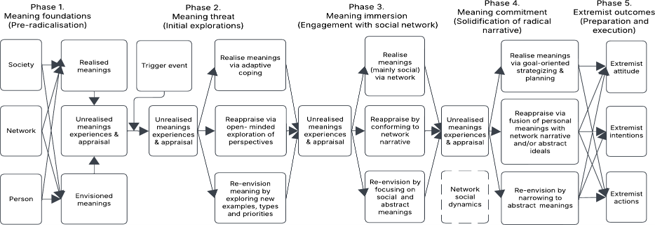
Radicalisation often happens through multiple radicalisation phases. Although most extremists radicalise linearly, from phase 1 to phase 2, etc., some individual skip a phase or return to an earlier phase. Radicalisation often consists of multiple cycles, such as an individual may only shift to a next phase, after they have repeatedly failed to realise their envisioned meanings in the previous phase.
Phase 1. Meaning Foundations (Pre-radicalisation)
· Social context: the society, social network(s), and/or personal life situation are not severely threatening/limiting and offer sufficient resources to realise the meaningful life and world individuals envision
· Envision meanings: individuals envision multiple (usually five or more) examples of diverse types of meaning in life. Individuals may use various approaches to find meaning in life, including following traditions and conforming to social expectations, and mechanistically striving towards large goals. These traditional-conformist and goal-oriented/mechanistic approaches to life are not rigid, and may go hand-in-hand with critical reflection and listening to what their intuition is authentically meaningful.
· Realise meanings: individuals realise multiple (usually five or more) examples of diverse types of meaning in life, without needing to use extreme methods or strategies
· Experience meanings: overall, individuals have positive experiences, and/or are able to regulate their emotions in a constructive way
· Appraise meanings: individuals have realistic explanations of their meaning-making and social context
Phase 2. Meaning Threat (Initial explorations)
· Social context: individuals experience various threats/limitations and fewer resources/opportunities to realise the meaningful life they envision, for example due to 'trigger events' in their society, social network, and/or personal life situation.
· Re-appraise meanings: individuals try to evaluate the threats/limitations and resources/opportunities in a realistic way, although some inconsistencies may appear in their explanations, and they may focus more on threats/limitations than on resources/opportunities.
· Realise meanings: individuals try-out new methods and strategies to realise the meaningful life and world they had envisioned; these trials are usually initially experimental in nature and not rigid, anti-democratic or violent.
· Re-envision meanings: individuals shift what they find meaningful in their life and world. This could include small or largers shifts in the everyday examples of meaning, or they may focus on a totally new type of meaning, or shift their priorities in life. They may also shift their approach to finding meaning, such as listening more to their tradition, community, or leaders, (social-conformist approach), using a more linear and goal-oriented approach (mechanistic/goal-oriented approach), and/or more critically reflecting and focus more on their intuitions to find out what they find authentically meaningful (critical-intuitive approach).
· Re-experience meanings: individuals may change how they experience their meaning-making and how they regulate their emotions and body, such as physical self-care, expressing their emotions to others, or suppressing their frustrations.
Phase 3. Meaning immersion (Engagement with social network)
Although most extremists engage with a social network in their radicalisation process, some 'lone wolves' skip this phase of immersion in a radical network.
· Social context: When individuals cannot find out on their own how to live a meaningful life, they will look around how other people do this. After having experienced repeated failures to realise the meaningful life and world they re-envision, individuals may turn to social radical networks.
· Realise meanings: Radical networks may offer resources/opportunities for meaning, such as offering practical materials, finances, and skills training (materialistic types of meaning), fun and creativity (hedonistic types), a sense of validation, status, or identity (self-oriented types), a sense of social belonging or helping others (social types), a larger pupose, values, ideology, or religion (large types), and abstract ideals (existential-philosophical types).
· Re-envision meanings: Radical networks may suggest new meanings to envision, which often shift away from superficial to deeper types of meaning, often with a stronger traditional-conformist focus and less focus on critical reflection and intuiting what is authentically meaningful.
· Re-experience meanings: Radical networks may offer new ways to experience their unrealised meanings. Individuals may experience a reduction of stress, thanks to the meanings they can realise in this network, and an experience of safety within this network. Meanwhile, radical explanations/re-appraisals may highlight threats/limitations in society or other social networks, which may trigger strong neurobiological, physical and emotional responses.
Phase 4. Meaning commitment (Solidification of radical narrative)
· Social context: While extremists may still envision and realise meanings in their extremist network, these meanings may become less important than abstract goals. For example, a white supremacist may start to experience their pure race ideals as more important than the white supremacist networks they belong to.
· Re-envision meanings: Individuals dominantly focus on one or two highly-important, social, large or existential-philosophical meanings in life. While they use their critical thinking and authentic intuitions at an asbolute minimum (critial-intuitive approach), they rigidly follow their traditions, leaders, and/or community (traditional-conformist approach), and become increasingly mechanistic and goal-driven in their approach (mechanistic/goal-oriented approach).
· Realise meanings: Individuals increasingly focus on developing strategies and concrete plans to achieve their extreme goals in a mechanistic/goal-oriented way.
· Re-appraise meanings: The personal meanings of the individual become fully fused with the network meanings and/or with the abstract (large or existential-philosophical) goals.
· Re-experience meanings: Extremists often show strong neurobiological and physical responses, such as stress 'being on edge', and experience and express strong secondary emotions, such as existential frustrations and outrage towards others.
Phase 5. Extremist outcomes (Preparation and execution)
· Extremist attitude: E.g., extremists condone violence or anti-democratic values, to achieve their extreme goals.
· Extremist intentions: E.g., extremists intend to use violent or anti-democratic methods and strategies
· Extremist actions: E.g., extremists commit to violent or anti-democratic actions, actively plan, and act on these.
What are examples of radicalisation of meaning-making in known terrorists?
Example: Rickard Andersson
On February 4, 2025, the quiet city of Örebro, Sweden, was shaken to its core. Rickard Andersson, a 35-year-old local resident, walked into Campus Risbergska, an adult education center, and opened fire. The attack left at least ten people dead and several others injured, marking it as one of the worst mass shootings in Swedish history. But how did a man, once described as a quiet loner, transform into a violent extremist?This tragedy has forced us to confront uncomfortable questions about radicalization, mental health, and the very fabric of our society. By understanding Andersson’s journey, we may find ways to prevent such horrors in the future and reflect on how we can build a more meaningful, inclusive society for all.

Phase 1. Meaning Foundations (Pre-radicalisation)
Rickard Andersson’s story begins in Örebro, a city in transition. Once an industrial hub, Örebro was shifting towards a service-oriented economy. This change, coupled with increasing economic inequality in Sweden since the mid-1980s, set the stage for Andersson’s struggles.Born in 1989 as Jonas Simon, Andersson’s early life was marked by academic difficulties. He attended Navets skolen for nine years without passing a single subject. Later, at Wadköpings utbildningscenter, he managed to pass only three subjects, failing seven others. These persistent academic failures likely planted seeds of inadequacy and resentment.A relative described Andersson’s childhood neighborhood as “prosperous,” highlighting a stark contrast between his surroundings and his personal circumstances. This disparity may have fueled a sense of relative deprivation, a key factor in many radicalization cases. As a child, Andersson had friends and participated in group activities. However, over time, he became increasingly isolated. This gradual withdrawal from social connections would prove crucial in his later radicalization.
· Society: Andersson grew up in Örebro, Sweden, a mid-sized city undergoing economic transition from industrial to service-oriented sectors. Sweden experienced increasing economic inequality since the mid-1980s (OECD, 2015), potentially creating a sense of relative deprivation. Changes in the labor market, including the decline of blue-collar union influence (Svallfors, 2016), may have contributed to feelings of disenfranchisement. Andersson grew up in what a relative described as a “prosperous area” (Avaz.ba, 2025), suggesting a contrast between his personal circumstances and his surroundings.
· Network: As a child, Andersson was part of a group of boys who played and gamed together (Aftonbladet, 2025), indicating initial social connections.Over time, he became increasingly isolated, described as a “recluse” and “loner” by relatives (BBC News, 2025; The Independent, 2025).
· Person: Born in 1989 as Jonas Simon to Swedish parents (Expressen, 2025).Struggled academically, attending Navets skolen for nine years without passing a single subject (Aftonbladet, 2025).Later attended Wadköpings utbildningscenter but never completed high school, passing only history, psychology, and an aesthetic subject while failing seven others (Aftonbladet, 2025).Moved out of his parents’ home in 2010 at age 21 (Aftonbladet, 2025).Had no taxable income since 2014, never held a state or municipal job, and never took out student loans (Expressen, 2025).Had possible mental health issues, as mentioned by relatives (BBC News, 2025; The Independent, 2025).
· Envisioned meanings: Likely envisioned a life of academic achievement, stable employment, and social connections within Swedish society.
· Realized meanings:
Academic failure and social disconnection.Sense of not meeting societal expectations.
· Unrealized meanings experiences & appraisal: Expectations of success and belonging in Swedish society were not met.The gap between his envisioned life and reality likely led to feelings of frustration and resentment.
Phase 2. Meaning Threat (Initial explorations)
The second phase of Andersson’s radicalization was marked by significant life events and a search for new sources of meaning. In 2017, at the age of 28, he changed his name from Jonas Simon to Rickard Andersson, taking his father’s pre-marriage surname. This act suggests a desire for a new identity, possibly an attempt to break from his troubled past.Andersson’s struggles continued into adulthood. He moved out of his parents’ home in 2010 at age 21 but failed to establish a stable life. From 2014 onwards, he had no taxable income, never held a state or municipal job, and never took out student loans. This long-term unemployment likely intensified his feelings of alienation and worthlessness.Adding to his frustrations, Andersson was repeatedly refused military service. For many young men, military service can provide a sense of purpose and belonging. Its denial may have further fueled Andersson’s resentment towards societal institutions.During this phase, Andersson likely began exploring alternative ideologies that could explain his perceived failures and provide a new sense of purpose. The internet, with its vast array of extremist content, may have played a crucial role in this exploration.
· Trigger event: Repeated rejection from military service (The Independent, 2025). Long-term unemployment, with no taxable income since 2014 (Expressen, 2025).Changed his name to Rickard Andersson in 2017, possibly indicating a desire for a new identity (Expressen, 2025).
· Unrealized meanings experiences & appraisal: Intensified feelings of failure and rejection by societal institutions.The continued disconnect between his desired life and reality may have intensified feelings of alienation and anger.
· Reappraise via open-minded exploration of perspectives: Possibly began exploring alternative ideologies or worldviews online.Andersson likely reappraised societal issues through the lens of extremist narratives, viewing immigration and cultural changes as threats to his identity.
· Re-envision meaning by exploring new examples, types and priorities: May have started considering extremist narratives that offered simple explanations for his struggles.Andersson probably began re-envisioning his role as a potential “defender” of his perceived threatened culture or identity.
· Realize meanings via adaptive coping: Obtained a hunting license and legally owned multiple hunting rifles (The Independent, 2025; SVT, 2025).Was interested in ice hockey and enjoyed driving, considering becoming a truck driver at one point (Expressen, 2025).
Phase 3. Meaning immersion (Engagement with social network)
As Andersson’s isolation deepened, he appears to have immersed himself in extremist ideologies, likely through online communities. While specific details of his online activities are not available, research suggests that such communities often play a crucial role in reinforcing radical beliefs.Family members noticed a marked deterioration in Andersson’s mental state during this period. One relative reported, “He didn’t like gatherings. It irritated him. He wasn’t with his parents for Christmas. He wasn’t mentally well.” This withdrawal from family and increased irritability are common signs of radicalization.It’s during this phase that Andersson may have begun to view himself as part of a larger ideological struggle. Extremist narratives often provide a sense of significance to individuals who feel marginalized by society. For Andersson, these narratives likely offered an explanation for his struggles and a path to redemption.
· Unrealised meanings, experiences & appraisal: Continued unemployment and social isolation likely intensified feelings of alienation and anger.Mental health problems, combined with social isolation, likely intensified his search for meaning and significance (Bhui et al., 2014).
· Reappraise by conforming to network narrative: Likely began viewing societal issues entirely through an extremist lens, reinforcing his radicalised worldview. Sweden’s political discourse is increasingly focused on immigration-related issues, potentially reinforcing Andersson’s grievances. Media framing of integration challenges may have contributed to a polarised public debate (Rydgren & van der Meiden, 2019).
· Re-envision by focusing on social and abstract meanings: Andersson’s vision likely shifted towards a role as a significant actor in a larger ideological struggle, possibly seeing himself as a “warrior” or “martyr” for his cause. Probably re-envisioned violent action as a means to achieve significance and make a lasting impact on society.
· Realise meanings (mainly social) via network: While specific information about Andersson’s involvement with extremist networks is not available, research suggests that online communities often play a crucial role in reinforcing radical beliefs (Koehler, 2022). Deeper engagement with extremist content and potentially like-minded individuals online may have provided a sense of purpose and significance.
· Network social dynamics: Family members noticed a deterioration in his mental state, reporting that “He didn’t like gatherings. It irritated him. He wasn’t with his parents for Christmas. He wasn’t mentally well” (Avaz.ba, 2025). Although Andersson acted alone physically, his radicalisation process may have been reinforced by online extremist communities or echo chambers that validated his beliefs (Koehler, 2022)
Phase 4. Meaning commitment (Solidification of radical narrative)
As Andersson’s radicalization progressed, his worldview likely became increasingly rigid and aligned with extremist ideologies. This phase is characterized by a fusion of personal grievances with broader extremist narratives.Interestingly, it was during this period that Andersson enrolled in several math courses at Risbergska adult education centre, with the last one in May 2021. This return to education might have been an attempt to address his past academic failures. However, it also familiarized him with the location that would later become the target of his attack.The planning and preparation for the attack likely provided Andersson with a sense of purpose and control that had been lacking in his life. In extremist ideologies, violence is often framed as a noble act of resistance or revolution. For Andersson, the idea of carrying out an attack may have seemed like a way to finally achieve significance and make a lasting impact on the world.
· Unrealised meanings, experiences & appraisal: The persistent gap between his radicalised vision and his actual life circumstances may have fueled a desire for drastic action.The final disconnect between his extremist vision and the reality of his actions may have manifested as a sense of inevitability or destiny.
· Reappraise via fusion of personal meanings with network narrative and/or abstract ideals: Andersson likely reappraised past events and current societal issues entirely through an extremist lens, reinforcing his radicalised worldview. He likely reappraised the value of human life, justifying potential victims as necessary sacrifices for his perceived greater cause.
· Re-envision by narrowing to abstract meanings: In the final stages, Andersson re-envisioned the attack as his defining life act, a way to permanently inscribe his significance in history and society. Andersson’s envisioned meanings likely centred on becoming a “hero” or “avenger” through a violent act, viewing it as a means of achieving ultimate significance.
· Realize meanings via goal-oriented strategizing & planning: Enrolled in several math courses at Risbergska adult education centre, with the last one in May 2021 (Aftonbladet, 2025), potentially influencing his later target selection. The planning and preparation for the attack may have provided a sense of purpose and control that had previously been lacking in his life. Began planning the attack, including the acquisition and preparation of weapons.
Phase 5. Extremist outcomes (Preparation and execution)
The final phase of Andersson’s radicalization culminated in the tragic events of February 4, 2025. On that day, he arrived at Campus Risbergska around lunchtime, carrying a guitar-like case. He entered a bathroom, where he changed into military-style clothing and armed himself with at least one weapon from the case.Andersson’s preparation was meticulous. He carried three guns and a knife, indicating extensive planning and a high level of commitment to his extremist beliefs. The choice of military-style clothing suggests he saw himself as a soldier in an ideological war.The attack itself was brutal and indiscriminate. At least ten people were killed, and six others were taken to the hospital with serious injuries. Eyewitness accounts suggest that Andersson spared certain individuals while targeting others, hinting at a possible ideological motive behind his choices.Police exchanged fire with Andersson during the incident, and he was ultimately found dead at the scene, likely from a self-inflicted gunshot wound. The attack sent shockwaves through Sweden and beyond, prompting soul-searching about the roots of extremism in society.
· Extremist attitude: Developed a complete embrace of a radical ideology that justified violence as a means to achieve significance (Kruglanski et al., 2019). The choice of an adult education centre as a target might indicate resentment towards educational institutions and the social integration they represent (SVT, 2025; The Guardian, 2025).
· Extremist intentions: Decided to carry out a mass shooting at Campus Risbergska, a place he once attended. The possession of legal firearms and extensive preparation, including changing into military-style clothing before the attack, indicate a high level of commitment to his extremist beliefs (The Independent, 2025).
· Extremist actions: On February 4, 2025, Andersson arrived at Campus Risbergska around lunchtime, walked around briefly, then entered a bathroom with a guitar-like case (Aftonbladet, 2025). He changed into green military-style clothing and took out at least one weapon from the case (Aftonbladet, 2025; The Independent, 2025). Andersson carried three guns and a knife during the attack, indicating extensive preparation (The Independent, 2025). At least ten people were killed, and Andersson was found dead at the scene (ITV News, 2025). Six people were taken to the emergency department at Örebro University Hospital, with five described as seriously injured (ITV News, 2025). According to anonymous sources, Andersson reportedly spared certain individuals while shooting others (TV2, 2025). Police exchanged fire with Andersson during the incident (The Independent, 2025).
· Attack Aftermath: The attack is considered Sweden’s worst-ever mass shooting (The Guardian, 2025). Police conducted a large-scale search operation at Andersson’s residence, using drones and heavily armed officers (The Independent, 2025). Swedish King Carl Gustaf and Queen Silvia, along with Prime Minister Ulf Kristersson, visited the site and attended a remembrance service (The Guardian, 2025).All government buildings and royal palaces in Sweden flew flags at half-mast from 9 am on February 5, 2025, to commemorate the shooting (The Independent, 2025)
Key Processes Throughout Radicalisation
Rickard Andersson’s journey from a socially isolated individual to a mass shooter illustrates the complex interplay of personal, social, and societal factors in the radicalization process. His academic struggles, long-term unemployment, and social isolation created vulnerabilities that, when combined with broader societal changes and exposure to extremist ideologies, led to a progressive embrace of violent extremism. The MOSAIC model helps us understand how Andersson’s quest for personal significance and meaning, in the context of perceived societal injustices and reinforced by online echo chambers, ultimately resulted in the tragic attack at Campus Risbergska.
· Narrowing of meaning types: Andersson appears to have focused increasingly on abstract types of meaning, dismissing self-oriented, hedonistic, or materialistic types (Vos, 2023).
· Shift in approaches to meaning: There was likely a move towards a more rigid goal-oriented approach focused on carrying out his attack, as evidenced by his extensive preparation and choice of multiple weapons (The Independent, 2025; Vos, 2023).
· Reappraisal: Andersson reinterpreted his life experiences and societal events through the lens of his extremist ideology, possibly viewing his unemployment and social isolation as justifications for violence (Park, 2010).
· Practical realization skills: He developed new skills aligned with his extremist goals, such as planning the attack, changing into military-style clothing, and using multiple weapons (Kruglanski et al., 2019; The Independent, 2025).
· Re-envisioning meanings: Personal and societal meanings were reconstructed to fit his new radical worldview, potentially seeing violence as a means to achieve significance or revenge against perceived societal injustices (Park & Folkman, 1997).
Commonalities with Other Extremist Cases
· Search for meaning: Like many other extremists, Andersson’s radicalisation was driven by a fundamental need for personal significance and meaning (Kruglanski et al., 2019). His academic failures, long-term unemployment, and social isolation created a fertile ground for extremist ideologies that promised a sense of purpose and importance.
· Gradual Progression: Andersson’s radicalisation followed the typical phases outlined in the MOSAIC model, from initial meaning foundations through to extremist outcomes. This gradual progression is a common feature in many radicalisation cases, highlighting the importance of early intervention (Vos, 2023).
· Online Radicalisation: While specific details of Andersson’s online activities are not available, the role of internet communities in fostering extremist beliefs is a well-documented trend in modern radicalisation processes (Koehler, 2022).
· Response to Societal Changes: Andersson’s apparent resentment towards societal changes, particularly related to immigration and cultural shifts, mirrors broader trends of right-wing extremism in Nordic countries (Rydgren & van der Meiden, 2019).
Broader Trends in Nordic Countries
Andersson’s case connects to wider patterns of radicalisation and violence in Nordic societies:
· Rise in Far-Right Extremism: Sweden and other Nordic countries have seen an increase in far-right extremist activities, often fueled by anti-immigration sentiments and perceived threats to national identity (Ravndal, 2018).
· Gang-Related Violence: While Andersson’s case is not directly related to gang culture, the increase in gang-related shootings in Sweden points to a broader issue of marginalised individuals seeking belonging and significance through violent means (Sturup et al., 2019).
· Lone-Actor Terrorism: Andersson’s attack fits into a concerning trend of lone-actor terrorism in Nordic countries, where individuals radicalise and plan attacks without direct organisational support (Schuurman et al., 2019).
Societal causes of Rickard Andersson's radicalisation
The broader problems mentioned in research on meaning in life help explain why there may be many potential “Rickard Anderssons” in Nordic society:
· Lack of Meaning-Oriented Education: Educational systems often focus on academic and vocational skills without adequately addressing students’ need for meaning and purpose, leaving individuals like Andersson vulnerable to extremist narratives (Vos, 2023).
· Decline of Meaning-Centered Communities: The erosion of traditional community structures and the rise of individualism have left many without strong social support networks or shared sources of meaning (Martela & Steger, 2016).
· Intergenerational Disconnection: Secularization and rapid societal changes have disrupted the transmission of intergenerational meanings, leaving some individuals struggling to find their place in society (Vos, 2023, 2020).
· Increased Societal Complexities: Globalization and technological advancements have created a more complex world, making it challenging for some individuals to navigate and find a sense of belonging (Kruglanski et al., 2019).
· Socioeconomic Pressures: Issues such as decreasing social mobility and the phenomenon of “generation rent” create economic stress and uncertainty, potentially fueling resentment and vulnerability to extremist ideologies (Standing, 2011).
· Impact of Crises: Economic downturns, pandemics, and other societal crises can exacerbate feelings of powerlessness and loss of meaning, creating conditions ripe for radicalization (Kruglanski et al., 2022).
Conclusions
The case of Rickard Andersson highlights the crucial role that meaning-making plays in the radicalization process. Throughout his journey, we can observe how his search for meaning and significance drove him towards increasingly extreme beliefs and actions.In the pre-radicalization phase, Andersson’s academic failures and social isolation created a void in his sense of purpose and belonging.
This lack of meaningful engagement with society left him vulnerable to alternative narratives that promised significance and clarity.During the meaning search phase, Andersson’s attempts to find new sources of meaning – through changing his name and seeking military service – reflect a desperate attempt to redefine his identity and find a place in society. When these efforts failed, he became more susceptible to extremist ideologies that offered simple explanations for his struggles and a clear path to significance.
The meaning immersion phase saw Andersson fully embracing extremist narratives as a way to make sense of his life experiences. These ideologies likely provided him with a sense of purpose, a clear enemy to blame for his problems, and a community (albeit a toxic one) that validated his feelings of resentment and alienation.In the meaning commitment phase, Andersson’s adherence to extremist beliefs became a central part of his identity. The planning of the attack gave him a sense of mission and importance that he had long been seeking. This commitment to a radical cause filled the void left by his inability to find meaning through conventional societal channels.
The final, tragic outcome of Andersson’s radicalization process demonstrates the dangerous potential of misdirected meaning-making. When individuals are unable to find positive sources of meaning and purpose in their lives, they may turn to destructive ideologies and actions as a way to assert their significance and leave a mark on the world.
Conclusion: A Call for Collective Action
The tragedy at Campus Risbergska is a stark reminder of the devastating consequences of radicalization. But it’s also an opportunity for reflection and action. By understanding Rickard Andersson’s journey through the lens of meaning-making, we can work towards creating a society that provides meaningful alternatives to extremism.
This requires a collective effort. Policymakers need to address systemic inequalities and provide robust support systems. Educators must help students find purpose beyond academic achievement. Mental health professionals need resources and support to reach those in need. Communities must create spaces for connection and belonging. And as individuals, we all have a role to play in fostering a society where everyone can find meaning and significance in constructive ways.
The path forward is not easy, but it’s necessary. By learning from this tragedy and taking concrete steps to build a more inclusive, supportive, and meaningful society, we can honor the victims of the Risbergska attack and work towards a future where such horrors become increasingly rare.In the end, the story of Rickard Andersson is not just about one man’s descent into extremism. It’s a call to action for all of us to reflect on how we can create a world where every individual has the opportunity to lead a meaningful life, contribute positively to society, and find purpose without resorting to violence or hate. It’s a challenging task, but one that’s essential for the safety, well-being, and flourishing of our communities and nations.
By embracing a meaning-oriented approach to societal organization, we can address the root causes of alienation, resentment, and extremism. We can create a world where individuals like Rickard Andersson are supported, valued, and guided towards positive sources of meaning long before they consider turning to violence. This is not just a utopian ideal, but a practical necessity in our increasingly complex and interconnected world.The journey towards a meaning-oriented society will require sustained effort, open dialogue, and a willingness to challenge entrenched systems and beliefs. But the potential rewards – a more resilient, compassionate, and fulfilling society for all – make it a goal worth pursuing with all our collective energy and creativity.
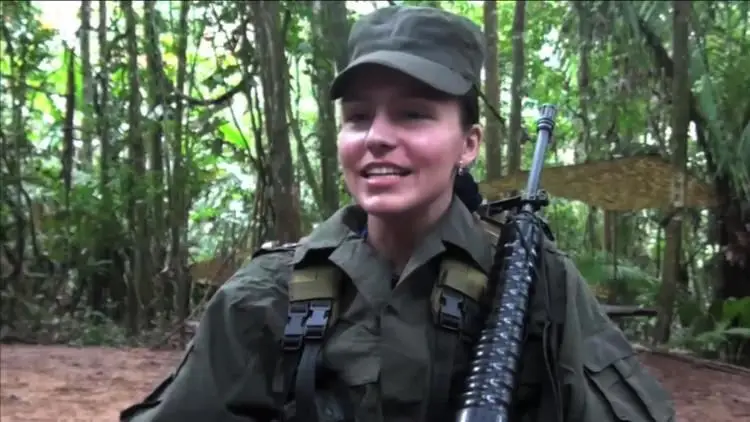
From Aspiring Nun to Guerrilla Fighter:
Tanja Nijmeijer's Radical Quest for Meaning
Tanja Nijmeijer’s life story is a compelling narrative of radicalization, illustrating how the search for meaning can lead an individual down unexpected paths. This analysis will explore her journey through the lens of the MOSAIC model, examining the phases of her radicalization process and the role that meaning-making played throughout her life. Her life story also demonstrates how former extremists can turn around, towards using non-violent, democratic methods and strategies to realise the meaningful life and world they re-envision.
Phase 1. Meaning Foundations (Pre-radicalisation)
Tanja Nijmeijer was born on February 13, 1978, in Denekamp, a small town in the eastern Netherlands near the German border. Growing up in a middle-class Catholic family, Nijmeijer’s early life was characterized by comfort and stability. This background is crucial to understanding her later choices, as it provided her with a sense of security that allowed for introspection and ideological exploration.
Her upbringing in a Catholic household initially shaped her approach to meaning. As a child, she dreamed of becoming a nun, indicating an early inclination towards a life of service and dedication to a higher purpose. This suggests that from a young age, Nijmeijer was seeking meaning beyond the material comforts of her middle-class existence.
Nijmeijer’s education played a significant role in shaping her worldview. She studied Roman Languages and Cultures at the University of Groningen, an experience that likely broadened her perspectives and exposed her to diverse ideas. During her university years, she transitioned from her Catholic upbringing to becoming what she described as a “diehard atheist.” This shift represents a critical re-envisioning of meaning in her life, moving from a religious framework to a secular one. The transition from religious belief to atheism is a significant example of meaning re-appraisal. It suggests that Nijmeijer was actively questioning the foundations of her worldview and seeking new sources of meaning. This process of questioning and searching would become a recurring theme in her life.
Phase 2. Meaning Threat (Initial explorations)
Societal factors: While we don’t have specific information about personal experiences of injustice in Nijmeijer’s early life, her later actions suggest a heightened sensitivity to societal inequalities. This sensitivity may have roots in her upbringing or education, possibly influenced by:
· The Dutch education system: known for emphasising global awareness and social responsibility.
· Exposure to leftist or socialist ideas during her university years
· Possible volunteer work or social activism during her youth: Though this is speculative, her later rapid radicalisation upon exposure to Colombian poverty indicates that she likely had a pre-existing framework for understanding and responding to social injustice, even if she hadn’t directly experienced significant personal hardships.
First Encounter with Colombia (1998): Nijmeijer’s first visit to Colombia in 1998 as a 20-year-old student marked the beginning of her self-identification with the country’s social struggles. This experience was pivotal in her radicalisation process, representing a significant meaning discrepancy between her previously held worldview and the reality she encountered. Her reaction to witnessing poverty in Colombia is telling: “I saw the poverty and I was really impacted by that. I started to question the capitalist system, everything around me.” This statement illustrates a profound reappraisal of her understanding of global economic systems and social justice. During this phase, Nijmeijer’s approach to meaning appears to have shifted from more materialistic, hedonistic, and self-oriented types of meaning (typical of her middle-class upbringing) to social, and particularly large and existential-philosophical types of meaning. She began to find meaning in understanding and potentially addressing societal inequalities.
Return to the Netherlands and Continued Reflection: After her initial visit to Colombia, Nijmeijer returned to the Netherlands to continue her studies. This period likely involved ntense reflection and meaning-making as she tried to reconcile her experiences in Colombia with her life in the Netherlands. She may have engaged in various activities to maintain her connection to the issues she encountered. She further studied Colombian history and politics, was involved in social justice or anti-capitalist groups in the Netherlands, and maintained contact with people she met in Colombia. This phase demonstrates the iterative nature of meaning-making. Nijmeijer was likely constantly re-evaluating her beliefs and values in light of her experiences, seeking ways to align her actions with her evolving worldview.
Phase 3. Meaning immersion (Engagement with social network)
· Indoctrination & 'brain-washing': Nijmeijer’s decision to return to Colombia marks the beginning of what may be described as 'indoctrination'. Coloquially, 'indoctrination' means brainwashing; it is the process of teaching someone a specific set of beliefs or ideas so thoroughly that they accept them without question, and the person stops thinking critically and will not consider other views. In networks like the FARC, this involves replacing personal autonomy with strict obedience to the group's revolutionary goals, ultimately normalizing the use of violent extremism to achieve political aims. In the MOSAIC Framework, 'indoctrination' means using social narratives, dynamics, real or imagined threats/limitations and resources/opportunities to make an individual find meaning by following a tradition and their leaders, and conforming to the social expectations of the community. On the one hand, indoctrination involves developing a radical traditional-conformist approach towards a specific tradition, leader(s) and community. On the other hand, indoctrination involves letting go of one's critical-intuitive approach, which means that an individual becomes less critical in their self-reflections and reflexivity, and starts to listen less to what their intuition tells is authentically meaningful to them. At this point, Tanja's search for meaning had led her to actively seek involvement in Colombia’s social and political struggles. This decision represents a significant step in narrowing her focus on a specific ideological path.
· Radicalisation through Personal Connections: A crucial element in Nijmeijer’s radicalisation was her relationship with a fellow teacher who later revealed himself as a FARC militant. This individual played a key role in her indoctrination process, taking her to city slums and framing FARC’s fight as a struggle for “social justice” in a country of deep inequalities. This period illustrates the power of personal connections in the radicalisation process. The FARC member provided Nijmeijer with a narrative that aligned with her evolving worldview, offering a concrete path to address the injustices she had observed. This narrative likely resonated strongly with her search for meaning, providing a sense of purpose and a way to act on her beliefs.
· Narrowing of the Number and Diversity of Meaning: During this phase, we see a narrowing of Nijmeijer’s sources of meaning. Her focus increasingly centred on the social and abstract (large and existential-philosophical) meanings found within the FARC’s ideology. This narrowing is characteristic of the radicalisation process, in which complex global issues are often reduced to simpler, more absolutist narratives. Nijmeijer’s approach to meaning during this time likely became more traditional, conformist, as well as more mechanistic/goal-oriented, and less critical-intuitive. The FARC’s clear ideology and mission provided a structured appraisal framework for understanding the world and its place in it.
Phase 4. Meaning commitment (Solidification of radical narrative)
Nijmeijer’s decision to officially join FARC in November 2002 marks her entry into the militantization phase. This choice represents the culmination of her radicalization process and a full commitment to violent extremism as a means of pursuing her ideological goals.Her statement, “I didn’t choose to use violence, I chose to do politics in a country where doing politics implies violence,” reveals her justification for this drastic step. This rationalisation demonstrates how Nijmeijer had reappraised the use of violence, viewing it as a necessary tool for achieving social change.
Phase 5. Extremist outcomes (Preparation and execution)
During this phase, Nijmeijer’s approach to meaning became heavily influenced by FARC’s ideology. Her sources of meaning narrowed further, primarily revolving around the group’s goals and her role within it. However, the entries in her diary, which were found and published publicly, suggest that she continued to grapple with meaning discrepancies, questioning the alignment between FARC’s stated ideals and the realities of guerrilla life.
Phase 6: Return to non-violent meaning-making
A significant shift in Nijmeijer’s journey occurred when she was named as a member of the FARC delegation in peace negotiations with the Colombian government in 2012. This transition from militant to peace negotiator represents a crucial point in her ongoing search for meaning.
This shift required a significant reappraisal of Nijmeijer’s approach to achieving social change. It demonstrates her ability to re-envision meaning, moving from a strictly traditional-conformist militant approach to one that embraces dialogue and negotiation. This transition suggests a return to a more critical-intuitive approach to meaning, where she could engage with complex ideas and contradictions rather than adhering to a rigid ideological framework.
Several factors may have contributed to Nijmeijer’s ability to transition from violent extremist to peace negotiator:
· Changing political landscape: The weakening of FARC’s military position and increasing international pressure for peace.
· Personal growth and reflection: Years of experience in FARC may have led to a more nuanced understanding of the conflict and potential solutions.
· Exposure to diverse perspectives: Interaction with hostages, including American contractors, may have broadened her viewpoint.
· Desire for change: Possible fatigue from the hardships of guerrilla life and a desire to find new ways to pursue her ideals.
Conclusion: A Continuous Search for Meaning
Tanja Nijmeijer’s life story, from her upbringing in the Netherlands to her role as a FARC guerrilla and later as a peace negotiator, can be framed as a continuous search for meaning. Throughout each phase of her journey, we see recurring themes:
· A persistent desire to address social injustice
· An ongoing process of questioning and reappraising her beliefs and actions
· A willingness to make dramatic life changes in pursuit of her ideals.
Tanja's journey illustrates the complex interplay between individual meaning-making and the broader social and political context. It demonstrates how the search for meaning can lead individuals down unexpected and sometimes extreme paths, but also how it can evolve and transform over time. Nijmeijer’s story serves as a powerful example of the role of meaning in the radicalization process, as well as in the potential for deradicalization and reconciliation. It underscores the importance of understanding the underlying motivations and meaning-making processes of individuals involved in extremist movements, offering valuable insights for prevention and intervention strategies.
How can meaning-making reveal a person’s radicalisation and extremism risks?
This table outlines key psychological and behavioral changes that happen when a person's core meaning-making capacities are threatened and they shift toward radicalization. It shows how individuals leave behind balanced, daily habits to seek intense meaning through abstract ideologies and extremist groups, while losing their capacity for critical thinking. Website viewers may use this as an analytical diagnostic checklist to identify the specific warning signs and structural shifts that occur during an ideological crisis. By reviewing the practical instances in the "Example" column, researchers and practitioners can better understand how abstract beliefs transform into concrete, goal-oriented plans to protect extremist networks.
How do conflicts escalate and polarise?
Conflicts: a general definition
“Conflicts” between people refer to disagreements that happen when two or more people, who depend on each other within a particular social context, experience that they cannot realise the meaningful life or world they had envisioned, due to the other party's real, symbolic, or imagined threats/limitations and resources/opportunities.
Conflicts: a MOSAIC Framework explanation
The MOSAIC Framework indicates that a conflict involves the following:
· Social context: The individuals/parties involved are linked, so one person's decisions and responses directly affect the other within their personal life situation, social network, or society.
· Envisioned meanings: The parties envision various meanings that they want to realise. These meanings could be materialistic (e.g., money, housing, possessions), hedonistic (e.g., fun, health, lifestyle), self-oriented (e.g., autonomy, recognition, creative self-expression), social (e.g., sense of belonging, altruism), large (e.g., specific purpose, ethics, values, religion, making the world a better place), and/or existential-philosophical (e.g., uniqueness, responsibility, freedom). Entrenched conflicts are often not what they seem to be about, as they involve multiple meanings, or the most important meanings are hidden and unspoken. For example, an employee may ask for a salary increase (materialistic meaning), but actually, they may want to be recognised for their contributions to the company (self-oriented meaning). A disagreement only escalates to become a conflict if something truly meaningful is at stake. Conflicts may be prevented by parties recognising each other’s envisioned meanings, or at least each other’s dignity, which is each party’s capability and right to their own meanings and meaning-making. For example, a team leader may organise group discussions about what the job means for the various team members (this only works if these conversations are authentic and involve no/few power imbalances).
· Unrealised meanings: One or more of the parties cannot realise the meaningful personal situation, life or world they had envisioned. Conflicts may be prevented when parties help each other realise what is meaningful to them. For example, an employer may regularly speak with their employees about how their job can help them feel a sense of fulfilment, and tailor their workload to offer opportunities to do so.
· Appraisal/explanations why one or more parties cannot realise the meaningful situation, life, or world they envision: One or more parties believe that they cannot realise the meaningful situation, life, or world they had envisioned, due to the other party’s threats/limitations and/or the unequal distribution of resources/opportunities. A disagreement only becomes a serious conflict if there is a real, symbolic, or imagined imbalance in the power to threaten/limit and/or offer resources/opportunities. Conflicts may be avoided by increasing equality/powers and resources/opportunities.
· Negative experiences of unrealised meanings: A disagreement only becomes a conflict if unrealised meanings are not merely theoretical, but also involve the body, emotions, and/or existential moods, such as hurt feelings, frustrations, sadness, or anger. Conflicts may be prevented by parties helping each other to reduce the physical, emotional, and existential impact of unrealised meanings. For example, an employer may offer space for emotional expression, and free counselling during reorganisation.
· Experiences of the unrealised meanings: A disagreement only becomes a conflict if unrealised meanings are not merely theoretical, but also involve the body, emotions, and/or existential moods, such as hurt feelings, frustrations, sadness, or anger. Conflicts may be prevented by parties helping each other to reduce the physical, emotional, and existential impact of unrealised meanings. For example, an employer may offer space for emotional expression, and free counselling during reorganisation.
Why do conflicts escalate and lead to polarisation?
Conflict becomes intractable when opposing groups mutually threaten each other's meanings and resources for a meaningful life, such as security, cultural practices, and political self-determination. Individuals may protect their group’s meanings by justifying hostility, supporting state-led violence or military actions, or participating directly in violent acts, although this increased hostility and violence may be perceived by the out-group as threats and as a decline in resources, prompting hostile, violent defences of their meanings. Thus, securing one group’s existential needs threaten another’s, fuelling escalating cycles of mutual existential threats and defences. These inter-personal vicious cycles of existential self-defence are often exacerbated by the narratives and social pressures/dynamics from political leaders and social networks, who may highlight grievances and increase in-group favouritism and out-group derogation.
Vicious cycles in conflict happen when people threaten each other’s meaningful everyday life in response to threats by the other to their meaningful everyday life.
How could mediators prevent, de-escalate, and solve conflicts?
The MOSAIC Framework of conflicts offers clear goals and tasks for mediators.
· Social context: Mediators should start by creating a comprehensive map of the conflict's social context, including narratives, resource distribution, social dynamics, relevant social networks, and personal life situations. This may reveal that there are structural social power imbalances between the parties. This may also reveal that the conflict is actually between different parties, such as an employee's redundancy may not be caused by the employer's bad intentions but by broader socioeconomic trends.
· Envisioned meanings: Mediators should: (1) identify the various meanings and the priorities among them that underlie the conflict, (2) affirm each party’s inherent human dignity as valid, autonomous meaning-makers, and (3) help the parties understand and affirm the other party’s dignity and, if possible, the meanings they envision.
· Unrealised meanings: Mediators should: (1) identify threats/limitations and resources/opportunities, (2) stimulate parties to understand, recognise, and change power imbalances.
· Appraisal of unrealised meanings: Mediators should: (1) differentiate between threats/limitations and resources/opportunities that are real and that symbolic, and/or imagined, (2) help the parties understand the reality of any power imbalance, and how the other party’s decisions and responses in light of this.
· Experience of unrealised meanings: Mediators should: (1) recognise the emotional charge of the conflict, (2) identify the underlying causes of these emotions, (3) create a sense of safety, safeness, and offer practical resources to lower the emotional charge, which may help the parties to look more rationally and realistically at the conflict and its possible solutions.
Why are armed conflicts and wars difficult to stop?
General definitions
· War: This usually refers to armed conflicts between sovereign nations.
· Armed conflicts: This usually more broadly encompass both international and non-international variants, involving state and non-state actors (Solis, 2021).
· Hybrids: Over the last years, war and armed conflict are increasingly hybrid, where internal disputes can internationalize through foreign/proxy intervention, blurring traditional boundaries, with varying parties, intensity, and blending traditional forces with tactics such as drones.
Example: In 2024, there were 204,605 distinct conflict events, with Sudan, Gaza, Myanmar, and Nigeria emerging as epicentres of casualties (acleddata.com), and an increased number of protracted conflict areas to 56 countries, particularly in post-Soviet spaces and the Middle East (Rustad, 2025).
The MOSAIC Framework of Armed Conflict
What does it mean to ‘optimally function’ during armed conflict?
· ‘The optimally functioning person will generally revise his or her constructions if they are invalidated, and construing is therefore a cyclical process in which the individual, similar to a scientist, constantly formulates hypotheses about his or her world, tests them out, refines them if necessary, and retests them’ (Winter & Feixas,2019,p.67).
· The psychiatrist Viktor Frankl mentioned about his experiences as a concentration camp prisoner that ‘an abnormal response to an abnormal situation is normal behaviour’, and that ‘it did not really matter what we expected from life, but rather what life expected from us. We needed to stop asking about the meaning of life, and instead to think of ourselves as those who were being questioned by life-daily and hourly. Life ultimately means taking the responsibility to find the right answer to its problems and to fulfil the tasks which it constantly sets for each individual’ (Frankl, 1948/1985, p.87).
· Although more systematic research is needed, it seems that individuals tend to have the following responses and decisions during armed conflicts, which may be described as ‘radical’ compared to everyday life, whereby some of these radical responses and decision may be seen as ‘normal’ (i.e., proportionate, ethical, helpful to the individual and society) and others as ‘abnormal’ (disproportionate, unethical, unhelpful)(Horgan, 2008).
· Most people seem to shift/radicalise gradually in response to threats and limitations/opportunities to the meaningful life they had envisioned, through non-linear, gradual, iterative rounds/phases of meaning-making attempts.
1. Re-experience unrealised meanings
Individuals in armed conflict often experience many threats/limitations and few resources/opportunities to realise the meaningful life and world they had envisioned. That is, people’s lives are threatened, and they may struggle to get external resources such as social connections, food, medicine, hygiene, housing, as well as internal resources such as effective coping and emotion regulation skills. For example, during missile attacks, ordinary meaning-making becomes almost impossible as schools and businesses close, and individuals seek refuge in bomb shelters. These threats/limitations and resources/opportunities may follow trigger events like missile attacks, or they may evolve more gradually due to micro-aggressions and small everyday changes.
Thus, armed conflicts may threaten and limit the number and types of meanings, as well as the approaches through which individuals can realize their envisioned meaningful life. Conversely, armed conflicts may also offer opportunities to discover new numbers, types, and approaches to meaning-making, such as developing personal resilience, focusing on life’s priorities and key values. supporting the community, peaceful resistance, and post-traumatic growth.
Various studies suggest that these radical re-appraisals, re-envisioned meanings and attempts to realize them during armed conflicts, are marked by heightened anger, grief, anxiety, and somatic symptoms such as chronic pain and fatigue; this emotional distress may subsequently deepen the commitment to radicalized beliefs, attitudes, and behaviors.
2. Re-appraise unrealised meanings
Confronted with the threats and limitations/opportunities to the meaningful life they had envisioned, individuals need to appraise the nature and magnitude of these threats (primary appraisal), the limitations and opportunities to cope with these threats, such as the availability of internal and external resources (secondary appraisal), and the successes/failures of their attempts to live a meaningful life despite these threats, limitations and opportunities (tertiary appraisal). For example, armed conflicts often challenge basic beliefs about life, such as life’s coherence, predictability, and benevolence, and may trigger denial/avoidance and rigid, black-and-white defences of one’s self-esteem and worldview.
In armed conflicts, individuals have reported a smaller number of meanings in their life, and a shift away from materialistic, hedonistic, and self-oriented types of meaning (e.g., finding meaning in possessions, career, sports) to social, large and existential-philosophical types of meaning, such as focusing more on the community, national or ethnic identity, justice, core values, religion and ideology. This shift may be practically explained by the restricted availability of resources to realize materialistic, hedonistic, and self-oriented types of meaning, but also the fact that these types of meaning are generally associated with smaller life satisfaction and well-being than social, large and existential-philosophical types. Thus, the community, national/ethnic identity, justice, core values, religion and ideology may be some of the few meanings that can be realistically achieved and offer a sense of meaning, life satisfaction and well-being amid turmoil
3. Re-envision meanings
In conflicts. the appraisal of the threats, resources, and meaning-making may become more polarized, absolutist, and conspiratorial, interpreting events through a black-and-white lens, attributing blame to external groups or forces.
4. Realise meanings
In armed conflicts, individuals are more likely to become more rigid and extreme in their methods and strategies to realize their meanings, such as participating in protests, leveraging social media to assert and defend their meanings, active militancy, activism or violence. These shifts may be explained as ways to defend themselves psychologically against the feelings of terror . Evolutionary and neurocognitive research may also explain the reduced use of critical-intuitive approaches to life, and the increase in traditional-conformist and goal-oriented/mechanistic approaches; when an individual’s Salience Brain Network detects existential threats, the brain may switch from the Default Mode Network (which is associated with critically-reflective and socially-complex meaning-making) to the Central Executive Network (which is associated with goal-oriented action).
Influences from the social context during armed conflict
Individual meaning-making in armed conflicts is often influenced by the narratives, resources, and dynamics of their personal life situation, community, and society . For example, extremist social networks, politicians and media may exploit people’s unrealized need for meaning by suggesting alternative, radical ways to appraise and experience their meaning-making failures, envision new/radical meanings, and realise social and self-oriented meanings through identity, belonging and involvement in the social network.
Polarisation & conflict escalation
Conflict becomes intractable when opposing groups mutually threaten each other's meanings and resources for a meaningful life, such as security, cultural practices, and political self-determination. Individuals may protect their group’s meanings by justifying hostility, supporting state-led violence or military actions, or participating directly in violent acts, although this increased hostility and violence may be perceived by the out-group as threats and as a decline in resources, prompting hostile, violent defences of their meanings. Thus, securing one group’s existential needs threaten another’s, fuelling escalating cycles of mutual existential threats and defences. These inter-personal vicious cycles of existential self-defence are often exacerbated by the narratives and social pressures/dynamics from political leaders and social networks, who may highlight grievances and increase in-group favouritism and out-group derogation.
How can meaning-making prevent and de-escalate conflicts?
Meaning in life is the most important source of resilience to cope with conflicts. If there is any hope left in a conflict, it will be found in meaning.
Meaning-making is a source of resilience during (armed) conflict
Individuals who maintain some sense of meaning in stressful situations are often more resilient, mentally and physically healthier, and less likely to support or engage in extremist networks and violence.
These findings align with research in the general public when there are no armed conflict, demonstrating that meaning contributes to psychological-existential resilience and well-being. For example, individuals report better life satisfaction, mental and physical well-being, psychological resilience and post-traumatic growth, if they:
(1) envision and realize five or more examples of meaning,
(2) realize some social and self-oriented types of meaning (amongst other types of meaning),
(3) dominantly use a critical-intuitive approach to life rather than dominantly relying on tradition or conforming to social expectations or leaders, or mechanistic goal-setting,
(4) realistically appraise their contextual threats and limitations/opportunities, and
(5) have flexible, action-oriented emotion regulation mechanisms.
We hypothesize that during armed conflict, individuals with these five optimal meaning-making characteristics experience larger well-being and are at smaller risk of radicalization, extremism and violence than those who do not have these characteristics. Consequently, individuals with these characteristics may be less likely to indirectly contribute to interpersonal vicious cycles of existential self-defence.
The Meaning-Making App
We developed the Meaning-Making App (MMA). MMA aimed to help civilians in armed conflicts maintain a sense of meaning in life, to improve psychological well-being and reduce risks of radicalization, extremism, and violence.
· Practical application of the MOSAIC Framework: MMA applied the comprehensive MOSAIC (Meaning Oriented Social and Individual Changes) framework, which indicates that well-being increases and risks decrease when individuals envision and realize five or more diverse types of meaning (mainly self-oriented and social), through critical-intuition, realistic appraisal, and emotion-regulation.
· Meaning-Making App Toolkits: MMA consisted of six toolkits, with tools derived from Systematic Meaning-Centered Psychotherapy: psycho-education about stress, trauma, and meaning; psychological first aid; brief meaning-making exercises; practical goal-setting exercises; structured meaning-making exercises; survivor stories. You may find some examples on this website.
· Evidence: Our research study indicated the feasibility of MMA. We included 142 MMA-participants from armed conflict zones (e.g., Israel, Palestine, Syria, Iran, Ukraine), who used MMA on average 70.92 minutes (SD=45.22), were satisfied with its content and impact, and recommended technical/offline improvements. Participants showed statistically significant improvements in meaning-making (measured with Short-Meaning-in-Life-Questionnaire. Meaning-Sextet-Questionnaire-Brief, Existential-Meaning-Regulation-Scale), well-being (PTSD-Check-List-5, General-Well-being-Item) and radicalization/extremism/violence risk-measures (Radicalism-Intention-Scale, General-Extremism-Scale , War-subscale of Attitudes-Toward-Violence-Scale). A non-randomized control-group of 57 individuals from Ukraine, Israel, and Palestine used the app without meaning components, showing no statistically significant changes in meaning-making and moderate changes in well-being and risk-measures. Statistical mediation analyses and structural equation models confirmed that improvements and MMA/control-group differences in well-being and risk-measures were mediated by meaning-making improvements. These findings should be interpreted cautiously given the non-randomized feasibility design, and the need for cross-cultural, longitudinal, multi-method validation.
· Conclusions: The findings suggest meaning-oriented smartphone interventions may improve well-being and reduce radicalization, extremism, and violence during armed conflict. This intervention study confirms other studies that indicate that meaning-making interventions can prvent and counter violent extremism (P/CVE) (Koehler, 2024).
· Next steps: The Meaning-Making App, and its underlying MOSAIC Framework, have shown to be very effective in helping individuals to live a meaningful life despite the (armed) conflicts of the social context they live in. However, the Meaning-Making App had many practical technological limitations as it was developed by Dr Joel Vos who is not an app expert. Furthermore, we need funding to scale-up and roll-out the Meaning-Making App to larger populations, so that more people living in armed conflicts can use the app, to be able to live a meaningful life despite the conflict's threats/limitations, and reduce the risk of radicalisation, violent extremism, and support of politicians who stand for violent interventions that polarise and escalate the conflict. Please use the contact form on this website if you want to support, fund, or scale-up the Meaning-Making App. To be fully transparent, my (Dr Joel Vos') goal of further developing and scaling-up the Meaning-Making App regard my social, large and existential-philosophical types of meaning: I want to help people live more meaningful, fulfilling, less-stressfull, happier lives, contribute to preventing and de-escalating (armed) conflicts and wars, and use my personal expertise and sense of responsibility to make the world a better place for all. Because everybody deserves to live a meaningful life.
Lobby for each person to live a meaningful life:
1. share positive visions for a meaningful society;
2. remove societal threats to people’s meaning in everyday life;
3. offer people resources (internal skills, opportunities);
4. teach emotion regulation and existential compassion.
How can existential compassion prevent and
de-escalate conflicts?
Our usual responses to extremists are ineffective
· “You are wrong because […] says so!”: The traditional-conformist response to extremists polarises between two traditions who feel more attacked & will defend themselves even stronger.
· “We act swiftly to arrest people who violate the law.”: Governments often use goal-oriented and mechanistic approaches. This does not address the existential concerns at the roots, and makes people more unjustly treated, feeling more righteous.
We need a new response. One that recognizes people’s underlying existential struggles.
We need a new response to radicalisation, that does not lead to escalation and polarisation.
One that recognizes people’s underlying existential struggles.
Existential compassion
Our world needs existential compassionto prevent being divided by opinionsand instead connect and support each otherin our human wish to live a meaningful life.
Why compassion and not empathy: Empathy means feeling ('pathos') within ('em') another person, which could be a psychotherapist, police officer, or politicians using and manipulating people's experiences. Our polarised world does not need to merely go into people's feelings, but sit next to them as a fellow-sufferer. Compassion means suffering ('pathos') with each other ('com') as equals. We are all born into life, extremists and non-extremists, with the unique threats/limitations and resources/opportunities of our unique postion in society, social networks, and personal life situation.
We are equal in birth and death, and thus equal in doubt and meaning about what we do in between. Consequently, everybody deserves to live a meaningful life.
Why existential compassion: Over the last decades, many studies have been conducted on the role of compassion by authors such as Paul Gilbert and Kirsten Neff. They show that compassion is vital for our well-being and social flourishing. However, they did not systematically address the existential dimensions of compassion.
Existential compassion consists of multiple components which can be summarised with the acronym 'HEARTS':
· H –Human dignity: respects a person's inalienable worth and value as a human being, enabling them to live a meaningful life with full authority to experience, appraise, envision, and attempt to realize their meanings on their own terms
· E – Embeddedness in a social context: each person’s unique meaning-making attempts are shaped by society, their social networks, and their personal life situation
· A –Attempts at meaning-making: a person’s beliefs, attitudes, and actions are attempts to realize the meaningful life they envision
· R – Reconstructing meanings and reconciliation: constructive meaning-making and reconciliation respecting everyone's dignity
· T –Truth telling: honest, compassionate truth-telling how people may have hurt each other
· S –Safety, safeness and fairness: The aforementioned aspects are only possible if there is:-Safety (negative): e.g., no abuse, violence and condemnation.-Safeness (positive): e.g., facilitating integrative Storytelling)-Resources: to actively recognize and empower individuals to help them realize their human dignity.
Dignity
Dignity is at the HEARTS of existential compassion. Dignity is at the heart of extremism, terrorism, and armed conflicts, as radicals do not respect the other person's ability and democratically recognised and protected right to their own meaning-making. Following a scoping review of the scientific literature, dignity may be defined with the following components that together create the acronym 'RESPECT'.
Dignity is an individual’s inherent ability and right, supported by social recognition and protection, to their own…
· R-Reflexivity: The ability and right to reflect on, interpret, and make sense of one’s own experiences, meanings, and meaning-making processes.
· E-Expression: The ability and right to express oneself authentically, participate in collective meaning-making, choose one’s social environment, and gain value from actions and social standing
· S-Selfhood: The enduring, inherent core of personhood and uniqueness that supports self-esteem and authentic identity.
· P-Purpose: The ability to envision, realise, appraise, and experience one’s own meanings in life
· E-Enablement: The presence of safety, privacy, and access to resources that remove barriers and support growth and autonomy
· C-Choice: The ability and right to make decisions about one’s life, including accepting, rejecting, or changing meanings imposed by others
· T-Totality: The ability and right to maintain an integrated sense of wholeness of body, mind, self-image, meaning, and morality, even through life’s inevitable limitations and societal challenges.
Being a rebel starts in everyday life
Living a meaningful life in a meaningless system is the ultimate act of personal rebellion against the system.
Because this individual shows the emptiness of the systemand reminds the people around them of the revolutionary dream of a system in which everyone can live a meaningful life.
Therefore, individuals living a meaningful life are the largest threats to dictators and fascists.
Frightened powerholders will allow individuals to suffer and to suppress their suffering with pills or hedonism, but they close churches, media, psychotherapy, music, and schools,and replace these with propaganda about their own meanings.
They monopolise the methods of mass production of meaning.
Therefore, we need to declare living a meaningful life an inalienable human right.
Because everybody deserves a meaningful life.
Everything can be taken from me but
my dreams about a better world.