Meaning & Purpose
What 10 facts should everybody know about Meaning and Purpose?
Meaning And Purpose 101 ™
Based on scientific research, systematically reviewed by Joel Vos
Winner of the first International Leadership Award for Distinguished Contributions to Existential Therapies Research
Meaning & Purpose 101 Fact 1.
Develop existential compassion for what truly matters to you and others
(Respect your and others' dignity to determine our own meanings in life)

Meaning & Purpose Fact 2.
Meaning in life is like the totality of the foundations beneath everyday life.
(Formal definitions of meaning include motivations, values, worldviews, self-worth, actions, flexibility, and commitment)
Meaning & Purpose Fact 3.
Don't build your life as a lone skyscraper that one crisis can topple.
Instead, raise a mountain range
of at least six diverse meanings,
so you always have a peak to stand on.
Meaning & Purpose Fact 4.
Listen to your intuition
and your body,
and be critical of what they tell.
Don't just conform to the crowd
or calculate your life like a machine.
You’ll find a well-being that others can’t dictate and goals can’t define.
Meaning & Purpose Fact 5.
To flourish, focus on social, large, and abstract types of meaning.
To suffer, focus on materialistic, hedonistic, or self-oriented types.
Meaning & Purpose Fact 6.
Live meaningfully
by navigating life’s storms:
realize your meaning as your anchor,
envision new horizons,
and steady your emotions
with a realistic assessment of the sea.
Meaning & Purpose Fact 7.
Just as a plant needs the right soil, sun,
and rain to thrive,
people only flourish when their social situation provides the right stories, resources, and dynamics to grow.
Meaning & Purpose Fact 8.
Beware the McMeaning Burger:
influencers and pop psychology
serve up a flashy, tasty high,
but it’s just existential fast food
that leaves you hollow.
For a life that actually sustains you,
seek authentic meaning from experts.
Meaning & Purpose Fact 9.
We are not given
an instruction manual at birth.
We need to
write and rewrite this ourselves.
Meaning & Purpose Fact 10.
Be a rebel
by living a meaningful life
in a meaningless world.
Explanations
What is the definition of meaning in life?
Why I do not talk about The Meaning Of Life
Few topics have been written about as much as "meaning." Over the centuries, thinkers have proposed countless definitions. Today, researchers usually divide meaning into three simple categories:
The Meaning of Life
This is the "cosmic why" and the ultimate purpose of the universe. It is the realm of prophets, holy books, religions, and philosophers. While inspiring, it can feel out of reach in our daily lives. I respect this big picture, but I leave the speculation to theologians, comedians, and Douglas Adams—who famously revealed the ultimate answer as "42."
Meaning in life
This is your personal, subjective sense of purpose. It includes your unique dreams, like building a career, starting a family, or buying a home.
Living a meaningful life
Life is more than just hitting major milestones. It is also found in tiny, everyday moments—like hearing a bird sing or receiving a smile from a stranger.
Examples: We all tend to find meaning in specific types of situations. For example, social connections are the most important to me. My days are filled with small, meaningful moments with friends, students, and strangers. ou can easily discover what matters most to you by keeping a simple daily diary. Just write down your three most meaningful moments each day. After a few weeks, look back. You will likely see a clear trend emerge. This pattern can help you decide how to shape your time—whether you want more of these moments or need to make a change. Improving your quality of life really can be that simple.This exercise does something else, too: it wakes you up to the countless intuitive ways you already find value in ordinary days. You do not need to constantly overthink the "meaning of life." Instead, you can focus on the third approach: living meaningfully. This is an ongoing, felt process of inhabiting your life moment by moment. It is guided by your intuition and gut feelings rather than cold logic. It is not a checklist—it is a flow.
How psychologists defined meaning in life
Psychologists focus on how individuals experience meaning in life, and live a meaningful life. They describe trends of what people experience as meaningful (descriptive), and do not say what people should find meaningful (prescriptive). Despite nuanced distinctions, most psychological definitions have most components in common, I found in a systematic review of definitions. The common denominator definition describes the experience of 'meaning in life' as a composite of seven deeply connected components: purpose/direction, values, coherence, significance/worth, practical skills, existential resilience, and commitment.
Motivation
A sense of purpose, goals, or directionality in life, although this directionality does not need to be in the form of specific future goals but could also be about the path towards the destination. I use the term 'motivation' as this comes etymologically from 'movere', which describes how people move from one to another point in life.
Values
How individuals move towards their goals in life in line with their subjective ethical norms and values.
Understanding of their context
An individual develops their sense of meaning in the context of their life story, generations before and after them, and it is this understanding of larger coherence that directs them in life.
Self-worth & significance
Individuals also need to feel worthy to follow their own direction in life and their own meaning needs to feel significant, instead of robotically following the expectations from family, friends, and society.
Practical skills
Living a meaningful life also includes practical skills, to translate the general sense of direction into specific steps, actions, and goals, for example via goal-management and self-regulation skills.
Existential skills
Individuals will also need existential skills to live a meaningful life in the face of their inevitable challenges and human condition.
Commitment
The experience of meaning in life needs all these components, and cannot be reduced to only one of these.
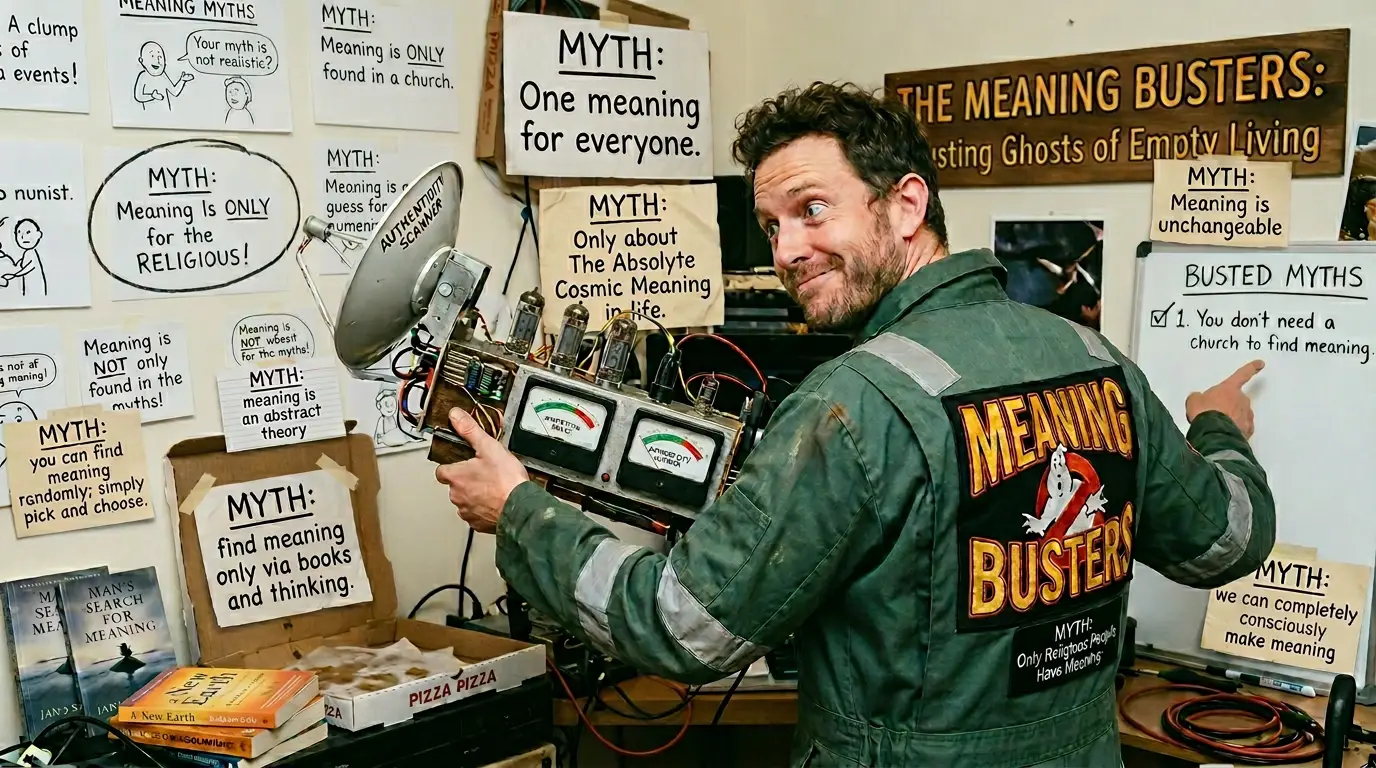
What are common myths about meaning in life?
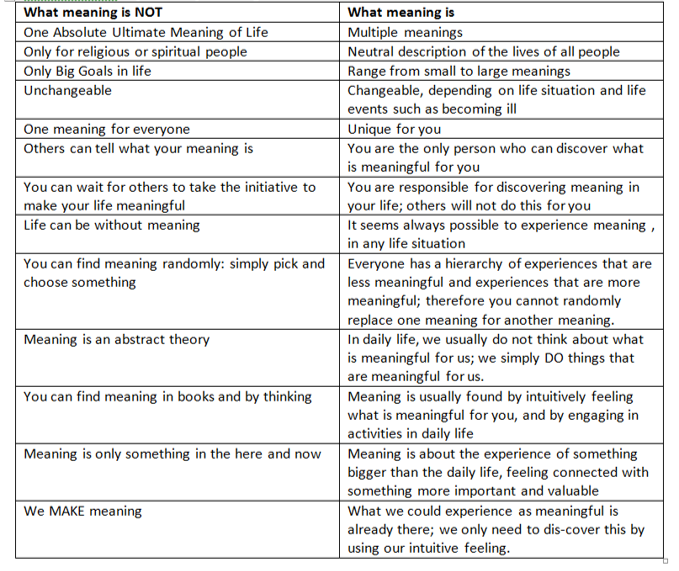
How many examples of meaning should we have in life?
Why you should have at least five meanings in your life
Having a meaningful life is not about finding just one single purpose. Our research shows that for optimal well-being and safety, you need at least five different sources of meaning. Here is why:
Don't put all your eggs in one basket
Relying on only one source of meaning makes you incredibly vulnerable. For example, during the pandemic, a football fan whose entire life revolved around going to the stadium suddenly lost their only reason to live. Having multiple anchors protects you when life changes.
Boosts your physical and mental health
Cultivating five or more meanings calms your autonomic nervous system and lowers stress. This biological shift directly boosts your immune system and physical health. People with five or more sources of meaning are significantly less likely to suffer from mental or physical health problems.
Protects against extremism
Studies on extremism and terrorism reveal that radical individuals usually have only one or two massive meanings in life. Because they have no other sources of purpose, they will defend those few meanings with extreme rigour and violence—it is all they have to live for. The fewer meanings you have, the more dangerously obsessed you can become.
Builds a stable pyramid, not a fragile needle
The famous psychiatrist Viktor Frankl compared meaning to a mountain range with peaks at various heights. Ideally, your life should look like a stable pyramid: a broad base of smaller everyday meanings (like having fun, enjoying a drink, or hobbies), a middle tier of important meanings (like friends and work), and a top peak of deeply vital meanings (like family life, a specific calling). You want a solid pyramid, not a fragile, top-heavy needle that easily topples over.
Have diverse types of meaning
The next sections describes the diverse types of meaning people could have in their lives.
Do you want to flourish in your life, improve your well-being, and reduce your risk of radicalising and extremism? Try to have some examples of all types of meaning in our life, with the main focus on social and large types of meaning. For example, if you only have social types of meaning, such as friends, family, and being a teacher, you may want to add some fun like going out, enjoying dinner or sports (hedonistic type of meaning), develop and care for yourself (self-oriented type of meaning), or focus on something larger than yourself and the people around like like via political involvement, studying history, or spirituality/religion (large type of meaning).
What examples do we find meaningful in life?
What are the 6 universal types & 27 sub-types of meaning?
The Universal Meaning Sextet
In 2024, I published the most ambitious, comprehensive review of all psychological studies on meaning in life ever conducted. I included all studies ever published on what people find meaningful or important in life, in any countries. I found clear the clear trend, that across cultures, individuals experience 6 types and 27 subtypes of meaning.
Materialistic type of meaning
These meanings describe the value of materialized situations, such as owning material goods or having achieved objective success. Some researchers have described this type of meaning as an example of relatively superficial meanings and hedonic well-being.
A. Material conditions
E.g., finances, housing, possessions, practical activities, physical survival
B. Professional-educational success
E.g., General success, professional success, educationalsuccess, social status, power
Hedonistic type of meaning
These meanings describe the value of the enjoyment and embodied experiences. Some researchers have described this type of meaning as an example of relatively superficial meanings and hedonic well-being. In my early research, I categorised hedonistic and materialistic types of meaning, but later questionnaire studies confirmed that these are two separate types of meaning.
A. Hedonistic and experientialactivities
E.g., hedonism, fun, leisure and joyful activities, enjoying beauty (music, art, eating, drinking, etc.), nature and animals, peak experiences, pain avoidance
B. Health & embodied experiences
E.g., being healthy, healthy lifestyle, sports, sex
Self-oriented type of meaning
These meanings describe the value of the self. Some researchers have described this type of meaning as an example of relatively superficial meanings and hedonic well-being.
A. Resilience
Coping successfully with difficultlife situations
E.g., flexibility, perseverance and hardiness, accepting challenges, effective coping skills, positive and hopeful perspective despite life's changes and challenges
B. Self-efficacy
Effective actions in daily life
E.g., setting specificactivities or goals, planning, organizing, discipline,evaluating and adjusting daily life activities orgoals, being in control
C. Self-acceptance
E.g., self-insight, self-acceptance, self-worth, self-esteem
D. Autonomy
E.g., self-reliance, non-selfish balance with social context
E. Creative self-expression
F. Self-care
Social type of meaning
These meanings describe the value of being-connected-with others, belongingto a specific community and improving the well-being of others. Some researchers have described this type of meaning as an example of relatively deeper meanings and eudaimonic well-being.
A Feeling socially connected
E.g., sociability, friends, family, intimate relationships/partner
B. Belonging to a specific community
E.g., family, community, history and society
C. Following social expectations
E.g., doing what is socially expected, following social virtues,conformism, tradition
D. Altruism
Helping others
E. Giving birth and taking care of next and previous generations
Large type of meaning
These meanings describe the value of something bigger than their materialistic or hedonic experiences, themselves andother human beings, merely for the sake of thatlarger value. Some researchers have described this type of meaning as an example of relatively deeper meanings and eudaimonic well-being. In some studies on radicalisation and extremism, I found overlap between large and existential-philosophical types of meaning, which I have together grouped as 'abstract types of meaning'.
A. Specific life purpose
E.g., specific larger goals, purposes, aims or dreams in life
B. Personal growth
E.g., self-development, self-transcendence, self-realization, fulfilling one’s potential, wisdom, authenticity
C. Temporality
E.g., sense of coherence, future-oriented, reflection on thepast, legacy, after-life, position in life-span,awareness of having little time or resources left
D. Justice & ethics
E.g., following ethical standards, being treated in a just way, contributing to a just world
E. Spirituality and religion
E.g., spirituality and religion, beliefs, worship and religiouspractices, insight in cosmic meaning, spiritual union,peace harmony and balance, Platonic Idea or Highest Good
Existential-philosophical type of meaning
These meanings describe the value of life as such. This type of meaning doesnot have a specific content like the other types ofmeaning but is more abstract: the mere fact thatsomeone is breathing and is able to make uniquedecisions within freedom is a gift to which onemay feel grateful and may want to respond to withresponsible decisions. Some researchers have described this type of meaning as an example of relatively deeper meanings and eudaimonic well-being.
A. Being-alive
E.g., being-born, feeling-alive, being-until-death
B. Uniqueness
E.g., the bare fact of our unique individuality of our own experiences, own life, own world and own self
C. Connectedness with theworld and others
E.g., the bare fact of being-in-the-world, being-in-context, being-in-relationships
D. Individual freedom
D. Freedom of decision
E.g., the bare fact that we are free to decide our attitude toward a limitation or any situation in life, the possibility to leave a legacy
E. Gratitude to life as a gift
E.g., Experiencing the mere fact of being-born as a gift ormiracle that one did not ask for but that oneregards as highly precious and special, and to whichone responds with gratitude
F. Responsibility
E.g., the bare fact that we are individually resonsible for ourselves, to live ameaningful life according to our highest values; nobody else can take over this ultimate responsibility from us
What types of meaning should you have?
Psychologists describe trends, and do not tell what people should do. You will need to find out for yourself and make your own decision what types of meaning you want to focus at. However, psychological research shows some trends, that you may want to consider.
Focus mainly on social and large types of meaning
Research shows that social and large types of meaning often lead to:
· Larger life satisfaction
· Longer-lasting, deep happiness and other positive emotions
· Better psychological health & well-being (e.g., fewer mental health problems)
· Better physical health & well-being (e.g., fewer physical health problems)
· Lower risk of political and ideological radicalisation and extremism
Individuals who introduce more examples of social and large types of meaning in their life show improvements in all these outcomes.
Focus less on materialistic, hedonistic, and self-oriented types of meaning
Research shows that materialistic, hedonistic, and self-oriented types of meaning often lead to:
· Lower life satisfaction
· Shorter lasting and/or more superficial happiness and other positive emotions
· Worse psychological health & well-being (e.g., more mental health problems)
· Worse physical health & well-being (e.g., more physical health problems)
· Larger risk of political and ideological radicalisation and extremism (having sufficient baseline sense of self can reduce risks, alongside having social and large types of meaning)
Individuals who start to focus less of materialistic, hedonistic, and self-oriented types of meaning in their life show improvements in all these outcomes.
Have diverse types of meaning
Do you want to flourish in your life, improve your well-being, and reduce your risk of radicalising and extremism? Try to have at least five examples of meaning in your life, ideally with examples of all types of meaning in our life, with the main focus on social and large types of meaning. For example, if you only have social types of meaning, such as friends, family, and being a teacher, you may want to add some fun like going out, enjoying dinner or sports (hedonistic type of meaning), develop and care for yourself (self-oriented type of meaning), or focus on something larger than yourself and the people around like like via political involvement, studying history, or spirituality/religion (large type of meaning).
The Meaning Sextet Questionnaire
Fill in the Meaning Sextet Questionnaire MSQ to discover which types of meaning are important to you, and which types you are (not) realising in your life.
The MSQ measures 6 types and 27 subtypes of meaning. The MSQ differentiates between the meaningful life you envision (your dreams), and the meanings you actually have in your life (your reality).
The MSQ was developed as the result via multiple studies:
(1) a systematic literature review of 107 studies in 45.710 participants,
(2) development by eight experts and Three-Step Test Interview with eight laypeople,
(3) a survey in 1281 participants in 49 countries,
(4) various replication studies.
This questionnaire can be used for personal or clinical use, but not for commercial profit. Respect the copyright holders.
How can we learn, make, or intuit meaning?
The thee universal approaches to meaning in life
The previous sections described the specific number of meanings and various examples of what people experience as meaningful in life. This section describes how we can learn, make, or intuit our meaning in life. These three approaches were derived from systematic etymological and historical reviews, and were empirically validated in various questionnaire and intervention studies.
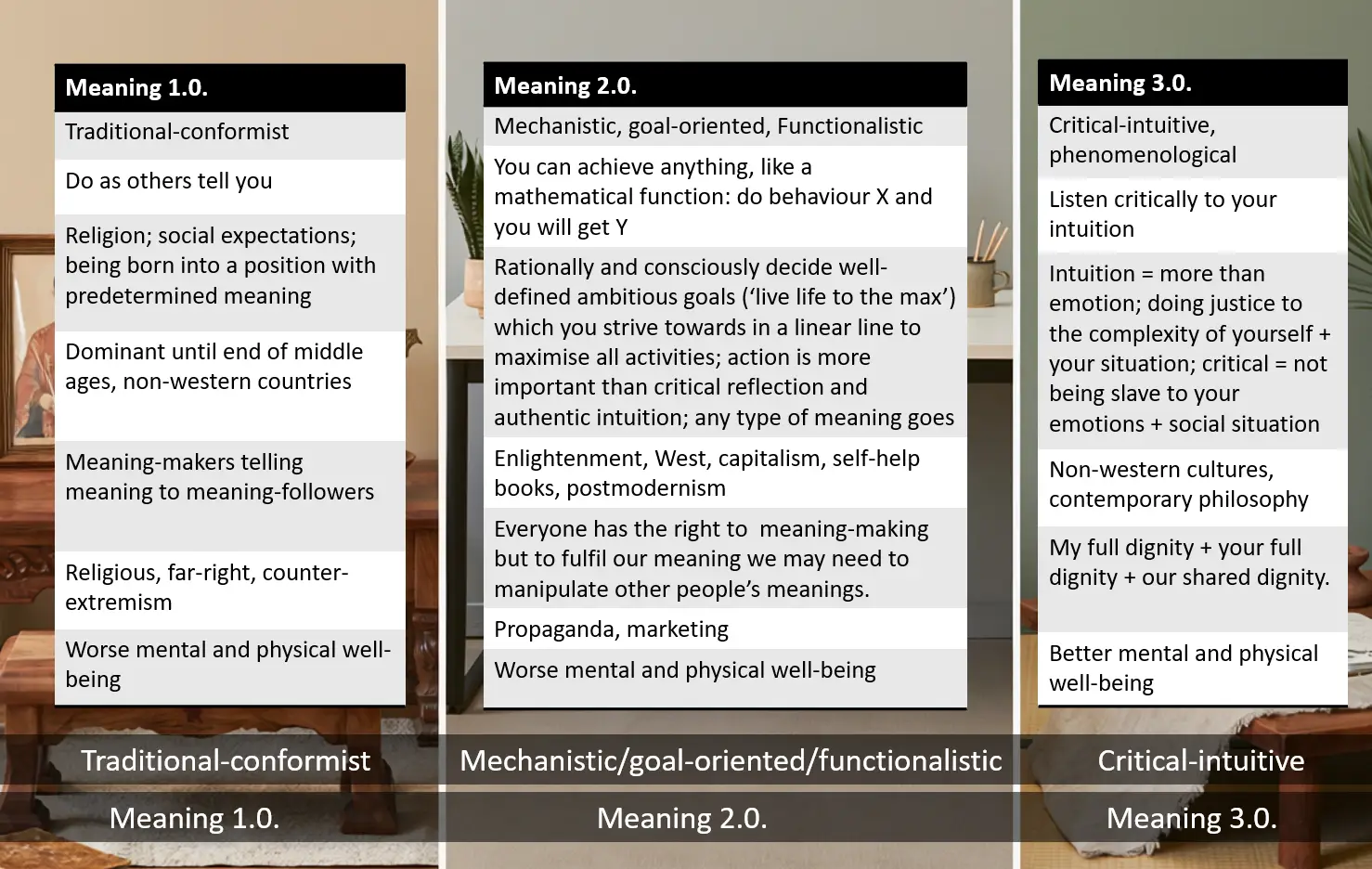
Meaning 1.0.: The traditional-conformist approach to life
The traditional-conformist approach describes how individuals develop their meaning in life by following and conforming to the explicit or implicit expectations of a tradition, leaders, and/or community.
'Learning', 'listening', or 'following' meaning:
The traditional-conformist approach can be seen in words, such as 'learning', 'listening', or 'following' meaning in life.
'Finding' or 'discovering' meaning:
Many traditions also speak of 'finding' or 'discovering' in life. The tradition tells people to believe that they have a pre-given meaning, unique essence, calling, or role in the universe, even if they cannot see this meaning yet. Individuals may 'find' or 'discover' this meaning, if they have faith it is there, and that they follow the tradition that may help them to un-cover or dis-cover their essence. If individuals cannot find their meaning, this could be attributed to their lack of faith, or misguidance from evil or satanic sources.
Informal motto: Do as others, an authority, or deity tells or show you
Components:
· Tradition: this could involve religious or secular, political or non-political communities with implicit or explicit expectations about specific types of meaning, socialisation and implicit or explicit rules about who can decide what is meaningful
· Conformist: individuals conform to implicit or explicit social expections
Associated terms:
The oldest Indo-European terms all seem to involve an individual listening to what others, an authority or deity told them, or to look at their signs:
· Significance, Significado (from 'signum', being shown a sign)
· Bezeichnis, Betekenis, Token (from 'teikan', being given an omen or message from God)
· Vocation (from 'vocare', being communicated)
· Beruf, beroep (from being communicated)
· Original use of the word Meaning, Meinung, Mening, Mahna (from originally referred to an individual being communicated to or being given directions, such as describing that God’s will was communicated (“ge-meint”) through their life, by being in service to the society, clergy, and God, thus without the individual deciding their personal meaning)
History: Dominant until the end of middle ages, in non-western countries. For example, Luther explained how an individual could be called by God: God is milking the cows through the vocation of the milkmaid.
Cultures: Dominant in western cultures until the Middle Ages, with a gradual decline until the mid 20th century when it quickly weakened; dominant during the 20th and 21th century in many other countries and cultures
Role of dignity: There is a hierarchy, often with an elite of meaning-makers telling followers what their meaning in life is.
Examples: Traditional religions (NB: there are also goal-oriented/mechanistic and critical-intuitive religions), ideological or political cults, extremists
Impact on well-being: Associated with worse life satisfaction, mental health, physical well-being, and less, shorter-lasting or more superficial happiness
Meaning 2.0.: The goal-oriented, mechanistic, or functionalistic approach to life
The goal-oriented, mechanistic, or functionalistic approach describes how individuals decide their own, often ambitious, goals in life, and try to realise this in the most direct linear way possible, often without deep justifications, introspection, or what their experiences and intuitions tell them is authentically meaningful.
'Make meaning'
The expression 'meaning-making' refers, in its strict sense, to a goal-oriented, mechanistic, or functionalist approach to meaning. Thus, when a person says they 'make meaning', they may (unconsciously) refer to this approach that dominates modern western countries. However, in everyday life, the term 'meaning-making' is often losely used, to refer for all approaches in life (although I usually prefer more inclusive terms, if I use the term 'meaning-making', I use this in the loose way, to refer to all meaning approaches).
Informal motto:
You can achieve anything, like a mathematical function: do behaviour X and you will get Y
Components:
• rationally and consciously decide meaning in life
• well-defined goals in life
• large ambitious goals (‘live life to the max’)
• move towards goals in a linear line
• maximise every activity to achieve goals efficiently
• action more important than critical reflection and authentic intuition
• equivalents of meaning: randomly select and replace meanings
• types of meaning are irrelevant, e.g. materialistic and hedonistic
• compete and fight for the survival of their personal meaning.
Associated terms:
From the 16th century, new words emerged in Indo-European languages that reflected a goal-oriented, mechanistic, or functionalistic approach to life, whereby individuals pro-pose meanings as self-chosen, well-defined specific goals in life:
· Purpose, Proposito (derived from pro-ponere, to post/put/place forth)
· Goal
· Later use of the term Meaning, Meinung, Mening (In most Indo-European languages, the word Meinung started to have negative and mundane connotations, such as implying subjective random opinions, childish desires, vulgarity, etc.)
History: Developed during the Rennaissance, Protestant Reformation and Enlightenment in Western countries, underpinning meaning in capitalism and postmodernism
Cultures: Dominant in modern and contemporary western cultures
Role of dignity: Everyone has the right to meaning-making but to fulfil our meaning we may need to manipulate other people’s meanings.
Examples: Self-help books, propaganda, marketing
Impact on well-being: Associated with worse life satisfaction, mental health, physical well-being, and less, shorter-lasting or more superficial happiness
Existential Fastfood: This type of meaning is like a 'McMeaning Burger' that offers short-term satisfaction of our existential hunger, but leads to long-term lack of existential nutrients and vitamins. Its consequences could involve vulnerability to promises of meaning by social networks and charismatic figures, meaning-related mental and physical health concerns.
Meaning 3.0. 'Intuiting meaning':
The critical-intuitive or phenomenological approach to life
The critical-intuitive approach to life involves individuals listening to what their intuition says is authentically meaningful. However, this intuition is not blind, as it involves critical reflection and reflexivity about one's own intuitions and influences from others.
Informal motto: Listen critically to your intuition
Associated terms:
During the late Middle Ages, the new term Sinn emerged. The medieval mystic Meister Eckhart and the church reformer Martin Luther used Sinn to describe meanings that were neither predetermined by a cosmic-divine-societal order (e.g., the traditional approach in significance and vocation) nor purely subjectively and randomly pro-posed (e.g., the functionalistic approach of meaning and purpose):
· Sinn, Zin, Sense, Sensida, Smesl, Senso, Sentido, Smisla (from 'sintere', perceiving with all our senses; this goes beyond the dichotomy of the world/others telling us our meaning versus us imposing our meanings onto the world/others)
Components:
· Intuition: more than emotion; doing justice to the complexity of yourself & your social context
· Critical: not being slave to your emotions and social situation
History:
The critical-intuitive approach was first described in Western countries by Christian mystics such as Meister Eckhart, but only become more popular by the late 20th century in Western countries. In other cultures and religions, many examples can be found of a critical-intuitive approach, although they often went hand-in-hand with traditional-conformist approaches, such as early Hinduism, Buddhism, and Confucianism. In Western philosophy, this approach has been systematically described by 'phenomenologists', such as Friedrich Nietzsche and Martin Heidegger (both explicitly referred to Meister Eckhart), which later inspired existential philosophers and existential psychologists.
Cultures: Weak across most countries, but increasingly important in western countries in the 21st century, such as modern spirituality that focuses on intuitions (althugh some spiritual traditions are less critical and more traditional-conformist) and 'quest religiosity' (such as some contemporary examples of liberal protestantism). There are long religious and cultural traditions of critical-intuition, such as Hinduism, Buddhism, and Confucianism, although their critical-intuitive approach was often been combined with traditional-conformist components (for example, some have critiqued Confucianism or Buddhism for having evolved into rigid traditions and conformism) or goal-oriented/mechanistic components (for example, some have critiqued some examples of New Age, modern Western spirituality, and Western Buddhism for superficiality, self-oriented focus, and mechanistic thinking).
Role of dignity: My full dignity + your full dignity + our shared dignity.
Examples: More dominant in non-western cultures, mystics, secular spirituality, contemporary philosophy and post-postmodernism
Impact on well-being: Associated with better life satisfaction, mental health, physical well-being, and more, long-lasting or deeper happiness
More details:
An individual “senses” their meaning in life, not as a passive outsider-perceiver of their life as an external reality but in a dynamic embodied act of mutual-meaning-construction between perceiving and perceived. That is, before we can reflect and verbalize our meaning in life, we are already phenomenologically engaged in our lifeworld, embedded in countless meaningful relationships that do not require a conscious act of knowing. Perceiving our meaning in life is like intuitively sensing how we already live meaningfully in our daily-life world, and experientially understanding the difference between what is more meaningful and less meaningful (which is possibly grounded in our evolutionary primal sense of meaning). However, this process of intuitive sensing is not blind, as it does not accept any random traditional or functionalistic meanings: it is critical toward others and oneself. When we sense our experiences of life with a critical intuition, meaning may reveal itself like a phainomenon; like the philosopher Martin Heidegger wrote that the ancient Greek word phainomenon etymologically means that which shows itself. Thus, the word Sinn seems to refer to a critical-intuitive sensing of our meaning and a phenomenological approach to life
How do people develop meaning over the lifespan?
The following trends in Western people during the late 20th century were found in several surveys and across the scientific literature. However, these trends need to be further confirmed across multiple cultures over time:
Children & young people
Focus on what people ‘must’ do, less on what they ‘can’ or ‘want’ to do. Dominant traditional-conformist approach, such as following what parents, teachers, authorities, and peers tell them, or explicitly or implicitly expect. Children and young people are relatively vulnerable to indoctrination and grooming by traditional-conformist networks and cults.
Adolescence & early adulthood
Focus on what people ‘can’ do, less on what they ‘must’ or ‘want’ to do. Dominant goal-oriented, mechanistic, or functionalistic approach, such as setting random ambitious goals, or focusing rigidly on building a career or family. Adolescents and early adults are relatively vulnerable to setting unrealistic materialistic, hedonistic, or self-oriented life goals, and try to achieve these at any cost, even if this hurts themselves or others.
Quarterlife & midlife
Focus on what people truly ‘want’ to do, less on what they ‘can’ or ‘must’. This period may be characterised by an existential crisis, as people experience the limitations of both the traditional-conformist and goal-oriented, mechanistic, or functionalistic approach. Some individuals may try out a more traditional-conformist approach to find deeper life satisfaction and life priorities. In response to quarterlife and midlife crises, some individuals may increasingly rigidly hold on to a traditional-conformist or goal-oriented/mechanistic approach, while avoiding or denying negative feelings, dissatisfaction, and frustration about life. In this period of searching and confusion, people may be more vulnerable to radicalisation and extremism.
Later life
After resolving the confusion in the previous life phases, individuals may developa balance and harmony between what they ‘want’, ‘can’, and ‘must’. People are more likely to develop a more critical-intuitive approach, possibly alongside other approaches, which helps them to embrace the complexity and nuances of life.
What is the best approach to meaning?
Psychologists describe trends, and do not tell what people should do. You will need to find out for yourself and make your own decision how you want to learn, make, or intuit meaning.
Combine various approaches
Most people combine all three approaches. For example, they may read books from experts on meaning or go to church services to get inspired, while they would not rigidly conform to their expectations. They may set some practical, habitual, not deeply reflected meanings in their everyday life, like they would not reflect deeply when choose products in the supermarket. Meanwhile, they may use critical self-reflection about themselves and the influences from their tradition, social expectations, and marketing, while they may explore their experiences to find out what feels intuitively authentically meaningful.
Mainly use a critical-intuitive approach
Research shows that dominantly using a critical-intuitive approach often leads to:
· Larger life satisfaction
· Longer-lasting, deep happiness and other positive emotions
· Better psychological health & well-being (e.g., fewer mental health problems)
· Better physical health & well-being (e.g., fewer physical health problems)
· Lower risk of political and ideological radicalisation and extremism
Individuals who develop a more critical-intuitive approach show improvements in all these outcomes.
Use less a traditional-conformist, or goal-oriented/mechanistic approach to life
Research shows that dominantly using a traditional-conformist, or goal-oriented/mechanistic approach often leads to:
· Smaller life satisfaction
· Shorter-lasting, more superficial happiness and other positive emotions
· Worse psychological health & well-being (e.g., more mental health problems)
· Worse physical health & well-being (e.g., more physical health problems)
· Larger risk of political and ideological radicalisation and extremism (developing a strong traditional-conformist approach, while reducing their critical-intuitive approach, is a key characteristic of extremism; in later stages of radicalisation, violent extremists and terrorists combine the traditional-conformist approach with a goal-oriented/mechanistic approach as they strive to realise their ambitious, abstract life goals in the most direct way possible)
Individuals who become less rigid in conforming to their tradition and/or less goal-oriented/mechanistic in their approach, while they develop a more critical-intuitive approach, show improvements in all these outcomes.
The Meaning Approach Scale
Fill in the Meaning Approach Scale MAS to discover how you approach meaning in life.
The MAS measures three approaches to meaning in life:
1. Traditional-conformist approach to life
2. Goal-oriented, mechanistic or functionalistic approach to life
3. Critical-intuitive or phenomenological approach to life
The questionnaire can be used for personal or clinical use, but not for commercial profit. Respect the copyright holders.
How can we live meaningfully despite personal or societal challenges?
The General MOSAIC Framework:
Meaning Oriented Social And Individual Changes
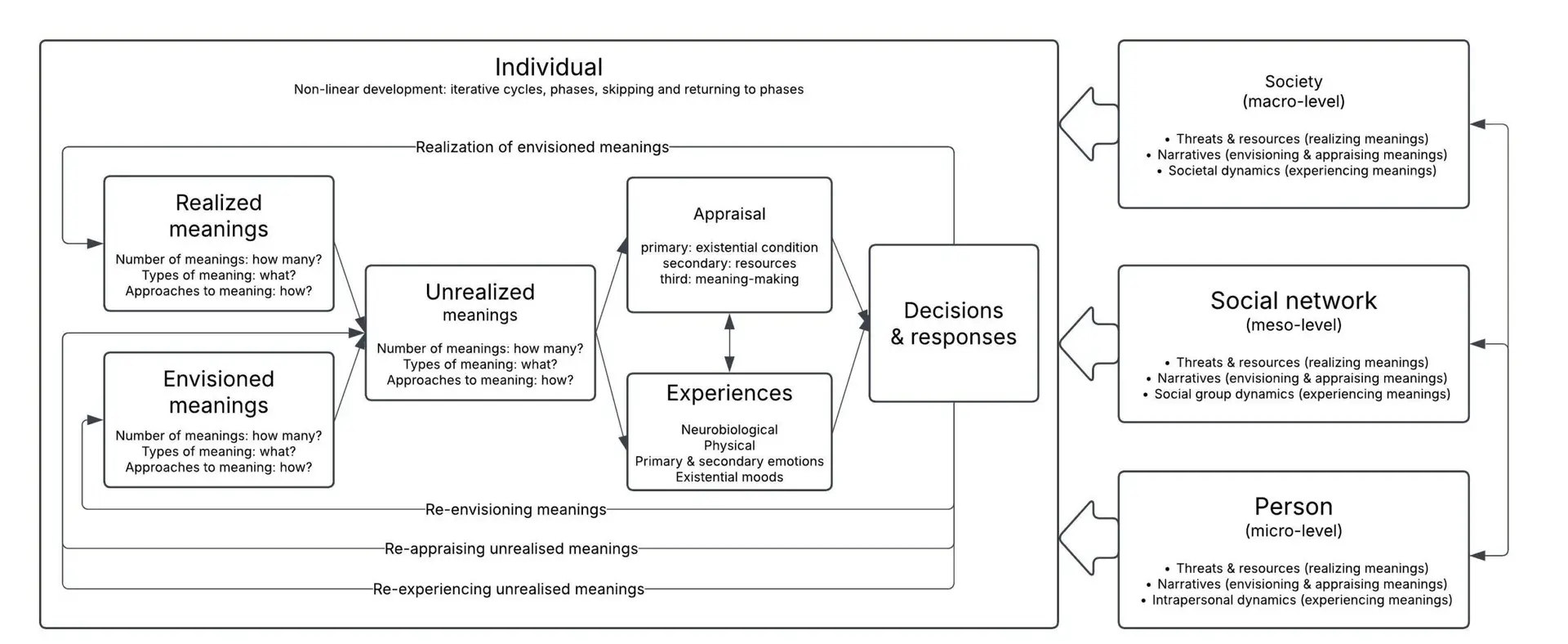
Responses & decisions to individual or social challenges & changes in life
When we can no longer realise the meaningful life we had envisioned, we generally have four responses and decisions:
1. Envision meanings
Change the meaningful life we envision
Examples: when we become unemployed, we may focus less on work and more on family
2. Realise meanings
Change the methods and strategies how we realise the meaningful life we envision
Examples: when we become unemployed, we may search for a job in a new sector, or decide not to work again
3. Appraise unrealised meanings
Change how we evaluate the threats/limitations, resources/opportunities, and meaning-making attempts
Examples: when we become unemployed, we may accept or suppress our frustrations, or turn these into public anger
4. Experience unrealised meanings
Change our neurobiological, physical, emotional, and existential responses
Examples: when we become unemployed, we may blame ourselves, our former employer, politicians, or minority groups
Social influences on our responses and decisions about meaning in life
Our responses and decisions about meaning in life are influenced by:
A. Society (macro-level)
· Threats/limitations & resources/opportunities: how we realise meanings in society
·Narratives: how we envision meanings & appraise unrealised meanings in society
· Social dynamics: how we experience meanings in society
Examples: politicians, education system, national economics, media, propaganda
B. Social network (meso-level)
· Threats/limitations & resources/opportunities: how we realise meanings in our network
· Narratives: how we envision meanings & appraise unrealised meanings in our network
· Social dynamics: how we experience meanigs in our network
Examples: political group, social media group, church, neighbourhood, school, community leaders, peer pressure
C. Personal life situation (micro-level)
· Threats/limitations & resources/opportunities: how we realise meanings in our life
· Narratives: how we envision meanings & appraise unrealised meanings in our life
· Social dynamics: how we experience meanings in our life
Examples: personal life experiences, upbringing, early life messages
What are practical steps to make our life more meaningful?
At the end of each day, write downthe three most meaningful moments of the day.
After two weeks, notice any important patterns.
Ask yourself what you can do to have moreof these important meanings in your life.
Get your calendar out & set notifications in your phone!
Plan at least…
...one huge meaning per year.
...one large meaning per month.
...one medium meaning per week.
...one small meaning per day.
Create regular evaluation moments
in your calendar & phone notifications..
...to feel the richness & celebrate successes of your meanings.
...to recognise any disappointments or frustrations.
...to evaluate how successful your meaning-making is.
...to adjust or add any goals.
...to assess your practical opportunities & limitations.
...to change your methods or strategies.
Surround yourself with reminders of your meaning:
Put family photos on your office desk.
Pin the concert ticket forever on your kitchen board.
Use screensavers of your loved ones,
Make, print & share photos of meaningful moments.
Self-help exercises to discover your meaning
Selection of short interactive exercise to discover your purpose and meaning in life
You can click on the link below to do several evidence-based exercises that will help you discover your sense of meaning in life.
These exercises use Microsoft Forms; we save any information only so that you can email the exercises at the end of the exercises to yourself; we will delete the data after a month.
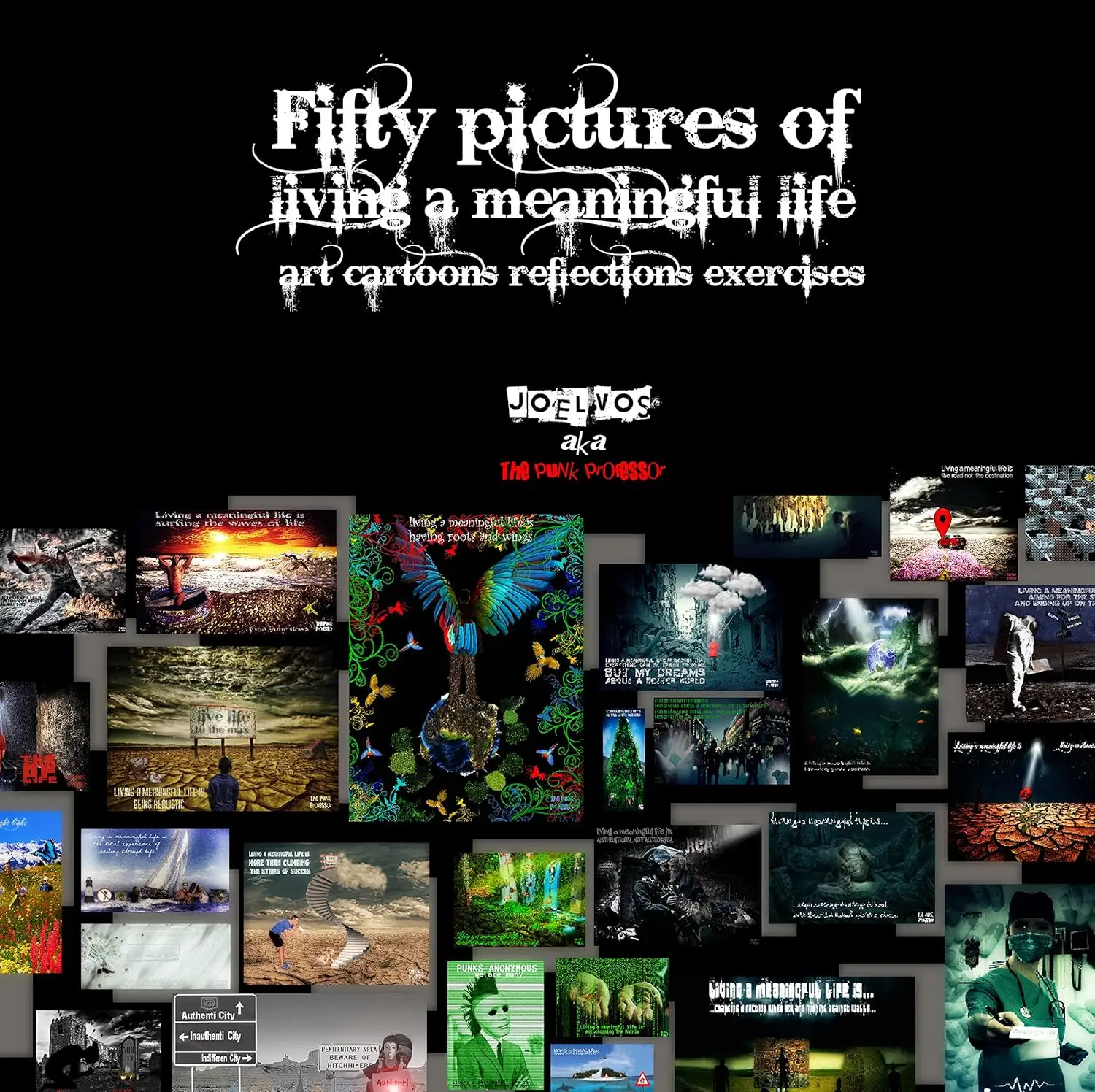
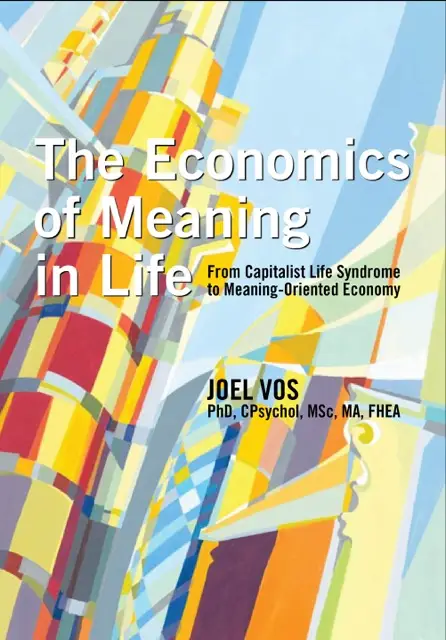
What are Joel Vos’ main books about meaning?
Where can we find
videos, lectures & podcasts to learn more?
Lectures & interviews
Short videos
Meaning And Purpose 101 ™
Lectures for practitioners