Meaning & Purpose
in Business & Economics
What are 10 key facts on Meaning & Purpose?
Meaning & Purpose 101™ in Business & Economics
Fact 1
We live in one of the
biggest economic revolutions for generations
as our socioeconomic behaviour is increasingly
motivated by meaning and purpose.

Fact 2
Modern consumers
do not want to buy a product or service,
they want to buy a meaning and purpose in life.
Fact 3
Benefits of workers' meaning and purpose:
1. lower stress
2. improved productivity
3. lower turnover
4. fewer sickness days
5. ...
Fact 4
Profit + purpose
=
profit 2 + purpose 2
Fact 5
Meaning and purpose
do not need to be fluffy.
They are evidence-based facts.
Companies benefit from
systematically applying these facts.
Fact 6
Fake purpose is corporate suicide.
Deceive your staff and customers,
and they will become the gravediggers
who bury your company.
Fact 7
Employees flourish when they focus dominantly on
social, larger or abstract types of meaning.
Employees suffer when they focus dominantly on
materialistic, hedonistic, or self-oriented types of meaning.
Fact 8
True leaders
first free people from the crowd,
then empower them to reach their goals,
and finally guide them to trust their own inner voice.
Fact 9
To improve your health & life satisfaction,
spend 40% of your waking hours
on what truly matters.
If your work isn't the source,
let it be the resource.
Fact 10
True Meaning in Life
cannot simply
be ordered and delivered
at your convenience.
Why do organisations increasingly focus on meaning and purpose?
We are experiencing a fundamental shift into a Meaning-Oriented Economy. Meaning is no longer a secondary perk, but a central economic reality discussed at leading global forums and embraced by multinational enterprises.
· Meets Shifting Work Attitudes: Next-generation workers explicitly seek personal, social, and societal fulfillment in their careers over purely material rewards.
· Addresses the Down-Shifting Trend: Elite talent is actively prioritizing meaningful responsibilities over higher-paying, transaction-based roles.
· Drives Core Corporate Strategy: Forward-thinking companies are embedding purpose directly into their core business plans to remain competitive.
· Protects Against Systemic Exploitation: True organisational transformation prevents the exhausting exploitation of workers' inner values.
How do meaning & purpose apply in the workplace?
Meaning in life
In everyday management, meaning and purpose can be defined as an all-inclusive framework (see the 'Meaning and purpose' webpage). It is not a single abstract concept, but a combination of practical components that dictate daily workspace behaviour:
· Motivation: Directing clear company goals, purpose, and productive forward movement.
· Values: Establishing the professional ethics and norms that guide corporate culture.
· Contextual Understanding: Showing teams how their daily tasks fit within the wider company mission and societal goals.
· Self-Worth: Ensuring every employee's dignity is recognised, respected, and valued.
· Practical & Existential Skills: Building the precise abilities needed to translate abstract visions into goals, face industry challenges, and manage market setbacks.
· Commitment: Cultivating a sustained, loyal engagement to execute goals in daily operations.
Existential compassion
Existential compassion means showing genuine curiosity about what employees and leaders actually want from their lives before making any attempts to force performance, debate targets, or correct behaviours. In our consultancy, this is delivered through a structured, evidence-based architecture summarised by the acronym HEARTS:
· H – Human dignity: Respecting a person's inalienable worth and value, enabling them to live a meaningful life with full authority to experience, appraise, envision, and attempt to realise their meanings on their own terms.
· E – Embeddedness in a social context: Recognising that each person’s unique meaning-making attempts are actively shaped by society, their corporate networks, and their personal life situation.
· A – Attempts at meaning-making: Understanding that an employee's beliefs, attitudes, and actions are direct, intentional attempts to realise the meaningful life they envision.
· R – Reconstructing meanings and reconciliation: Guiding constructive meaning-making, structural changes, and team-wide reconciliation that respects everyone's dignity.
· T – Truth telling: Creating a safe forum for honest, compassionate truth-telling regarding how people or corporate practices may have hurt each other.
· S – Safety, safeness and fairness: Actively guaranteeing a three-tier foundational environment:
· Safety (Negative): Zero tolerance for abuse, violence, or condemnation.
· Safeness (Positive): Proactively facilitating integrative storytelling and transparent dialogue.
· Resources: Providing the tools to actively recognise and empower individuals to help them realise their human dignity.
Dignity
Dignity is at the absolute core of existential compassion. When dignity is ignored, extreme workplace conflict, polarization, and structural breakdown follow. Backed by a comprehensive review of scientific literature, dignity in a forward-thinking enterprise is defined by the acronym RESPECT. Dignity is an individual’s inherent ability and right, supported by social recognition and operational protection, to their own:
· R – Reflexivity: The ability and right to reflect on, interpret, and make sense of one’s own daily experiences, meanings, and meaning-making processes on the job.
· E – Expression: The ability and right to express oneself authentically, participate in collective meaning-making, choose one’s work environment, and gain true value from actions and social standing.
· S – Selfhood: The enduring, inherent core of personhood and uniqueness that supports an employee's self-esteem and authentic professional identity.
· P – Purpose: The capability to freely envision, realise, appraise, and experience one’s own deep meanings in life and work.
· E – Enablement: The guaranteed presence of safety, privacy, and full access to operational resources that remove institutional barriers and support growth and autonomy.
· C – Choice: The explicit ability and right to make independent decisions about one’s life, including accepting, rejecting, or changing meanings imposed by others or rigid corporate structures.
· T – Totality: The fundamental right to maintain an integrated sense of wholeness across body, mind, self-image, meaning, and morality, even through life’s inevitable limitations and organisational challenges.
How are humans neurobiologically & evolutionarily wired to perform better in purpose-driven environments?
Human neurocognitive evolution shows that we are natural meaning-makers. Five primary brain structures dictate how employees and leaders handle workspace pressure and find real fulfillment (described with antropomorphic metaphors):
· The Instinctive Brain (subcortical brain structures): Acts as an inner watchdog focusing on survival, but can trigger destructive fight/flight/freeze reactions under threat.
· The Hunter & Gatherers Brain (Dorsal Salience Network): Constantly scans the workspace to evaluate external threats/limitations and available resources/opportunities.
· The Narrative Brain (Default Mode Network): Synthesises memories, social context, and goals into a coherent story, allowing for complex, pro-social, and global types of meaning.
· The Crafters' Brain (Executive Brain Network): Uses a targeted, mechanical approach to translate abstract ideas into clear, efficient staps and checklists.
· The Leaders' Brain (Frontal Salience Network): Acts as a strategic switchboard. When an executive or workplace culture creates constant pressure, it shuts down the narrative network to focus on immediate survival tasks.
Constant lack of safety or high-pressure tactics might drive short-term action, but they completely destroy long-term innovation, teamwork, and employee health.
How could employees and employers benefit from meaning and purpose?
Scientific consensus proves that integrating authentic purpose into daily operations creates an immediate, highly profitable win-win scenario for both directors and teams:
Stabilises Physical Health
Chronic workplace stress and job strain elevate long-term health risks, making cardiovascular disease the single largest cause of ill health-related workforce exits. Over 50 hours of work per week increases stroke risk by 35%. Improving a sense of meaning and purpose has proven to stabilize the autonomic nervous system, neutralizing stress-induced physiological wear and reducing long-term sickness absence.
Eradicates Workplace Burnout
Up to 84% of employees report facing at least one workplace mental health challenge annually.Value misalignment, lack of autonomy, and absence of recognition are the primary drivers of severe emotional fatigue.Securing authentic, data-driven recognition through the increasing meaning and purpose reduces severe negative emotional experiences by 30% to 40%
Supercharges Core Productivity
Low workforce engagement costs the global economy $438 billion in lost productivity.The average corporate employee operates at only 60% maximum productivity during a standard shift.Aligning daily tasks with a meaningful company mission increases focused baseline task performance by 13% to 20%.
Maximises Organisational Commitment
Employees who experience a weak sense of corporate belonging are 5 times more likely to actively look for a different job.Disengaged staff members are 12 times more likely to mentally detach from their roles entirely.Applying meaning and purpose-driven career pathing and structural value-alignment reduces initial staff attrition by up to 35% in year one.
Builds Systemic Resilience
High stress triggers cognitive overloads that completely halt corporate innovation and strategic adaptability.Companies scoring in the top 25% for integrated workplace experience generate double the return on sales and three times the return on assets.Building deep psychological safeness and structural resources provides the necessary buffer to maintain elite performance during market volatility.
Why should employees have 5 or more meanings (>40% time)?
People report better mental and physical health, life satisfaction, and productivity if they have at least five or more examples of meaning in their life, and/or spent at least 40% of their waking time for meaningful activities. Ideally, employees find examples of meaning both inside and outside their job, to create a large diversity and resilience of meaning. If an employer is unable to provide the opportunities/resources to employees to realise their meaning in life in the workplace, employers should at least give sufficient salary and work/life-balance so that employees can engage in their meaningful activities outside the workplace.
Relying entirely on a single source of meaning creates massive operational and personal vulnerability. The Meaning And Purpose framework structures a balanced variety of meaning anchors:
· Spreads the Existential Assets: Avoids "putting all your eggs in one basket" if a specific workspace project fails or is altered.
· Builds Exceptional Workplace Coping: Ensures employees stay flexible, adaptable, and emotionally stable during major industrial disruptions.
· Maintains a Healthy Work/Life Balance: Encourages alternate avenues of meaning outside the office to protect overall mental health.
· Secures Lifelong Engagement: Provides ongoing, non-exploitative opportunities to retain fulfillment after long-term illness or retirement.
Why should companies focus on social and larger types of meaning?
The Universal Meaning Sextet in the Workplace
A systematic review of 107 studies across 45,000+ individuals globally identified six universal types of general meaning, validated via the Meaning Sextet Questionnaire:
· Materialistic types: Financial aspects (salary, profits, stability, survival), production/exchange of goods and services, and achievements.
· Hedonistic types: Physical and emotional workplace experiences, pleasure, joy (creative process, beauty, flow, peak experiences), and avoiding pain/suffering.
· Self-directed types: Self-efficacy (using skills, hitting goals), resilience (flexibility, grit), personal identity, self-esteem via productivity and recognition, autonomy, creative self-expression, authenticity, and self-care.
· Social types: Social connection, community, role, status, and altruism (supporting, training, or serving colleagues, clients, or vulnerable individuals).
· Large types: Contributing to a larger purpose/mission, personal growth (self-realisation, fulfilling potential), justice, ethics, societal contribution, global coherence, and spiritual/religious callings.
· Existential-philosophical types: Freedom, responsibility, gratitude, uniqueness, and existential connectedness/isolation.
The Performance Impact
Individuals are mentally and physically healthier, reporting more joy and life satisfaction, when they focus predominantly on social, large, and existential-philosophical types of meaning, rather than solely on materialistic, hedonistic, and self-directed types. While materialistic, hedonistic, and self-directed elements are valuable, they are relatively less fulfilling and health-promoting in the long term. Professionals excel when they activate meaning associated with the narrative brain, not just the animalistic-instinctive brain.
Workplace Application
This exact pattern dictates workplace performance:
· Fewer Sick Days, More Innovation: Employees experience higher job satisfaction and superior well-being when they can realise diverse sources of meaning—predominantly social, greater, and existential-philosophical types.
· Modern People Strategy: Forward-thinking organisations look beyond basic salaries, team fun days, or individual self-care plans. They build authentic relationships with teams/clients and anchor operations in ethical or climate goals.
· Balancing Performance & Purpose: Enterprises integrate explicit dialogues regarding what employees find meaningful and what they need to achieve it, driven by structured job-crafting.
· Next-Gen Appraisals: Traditional annual reviews are upgraded to evaluate meaning and satisfaction alongside standard production and success metrics.
How do employees flourish when they follow their intuition instead of rigidly conforming?
The Three Universal Approaches to Meaning
History shows that meaning can be approached through three distinct individual attitudes:
· Traditional-Conformist Approach: Blindly following authority, rigid corporate hierarchies, or external expectations without personal alignment.
· Goal-oriented/mechanistic/functionalistic Approach: Viewing goals as a linear, disposable checklist to hit purely for career advancement, without deeper reflection.
· Critical-Intuitive Approach: Perfectly balancing clear, analytical evaluation with deep, authentic personal intuition.
Data proves that critical-intuitive workers enjoy greater career satisfaction, superior physical health, and are significantly more innovative. This can serves as the scientific engine behind modern self-management teams, human-first corporate leadership, and structured job-crafting.
Why do changing consumer preferences necessitate a meaning-oriented business design?
The Meaning-oriented Economy
The transition into a Meaning-Oriented Economy is a scientifically verified, highly profitable corporate evolution. Hard data across millions of corporate data points completely refutes the idea that purpose sacrifices profit:
Backed by Comprehensive Science: Fully synthesised from rigorous meta-analyses covering over 5,500 scientific publications.
Delivers Exceptional Financial Outcomes: Organisations that fully integrate purpose and profit experience a major surge in overall productivity, innovation, and baseline profitability.
Slashes Attrition Costs: Delivers a major, measurable reduction in employee sick leave and turnover ranging between 10% and 35%, often visible within the very first year of implementation.
Future-Proofs Human Intuition: Protects the critical-intuitive human edge against the rise of automated, target-driven artificial intelligence.
Consumer power
The current marketplace heavily punishes transactional business models. Modern buyers no longer look at product functionality alone; they evaluate a company's total systemic intent:
· Demands Complete Product Ethics: Consumers require that products are not just functional and affordable, but socially fair to workers and environmentally responsible.
· Aggressively Punishes Inauthenticity: The critical consumer market heavily penalises superficial marketing ploys, "greenwashing," or empty "purpose-washing".
· Accelerates Market Shifts: Forces sales, marketing, and operational teams to align corporate practice with actual public values to protect market share.
How does the MOSAIC framework empower teams to navigate adversity and setbacks?
The General MOSAIC Framework for Business & Organisations:
Meaning Oriented Social And Individual Changes
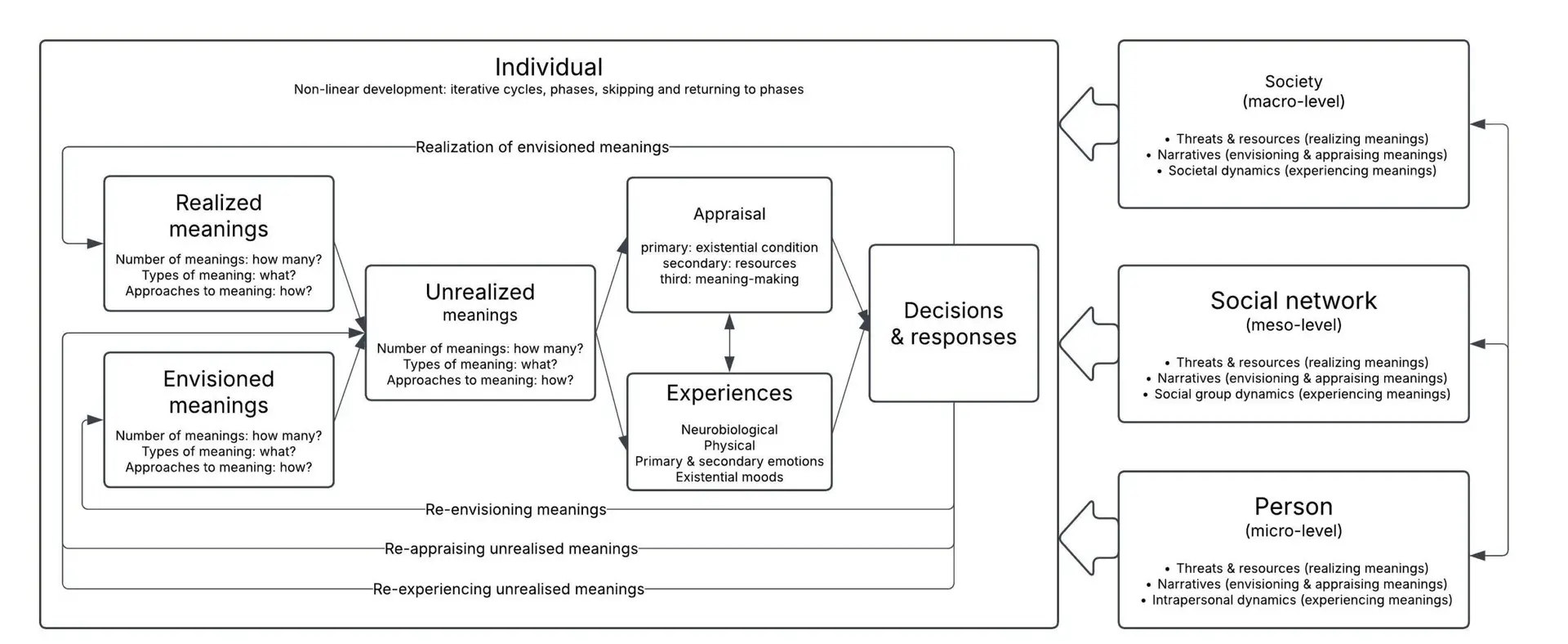
Responses & decisions to individual, organisational, or economic challenges & changes
When a friction gap appears between an individual's envisioned meaning (what they want out of work) and their realised meaning (the reality of their current role), operational stress occurs. The Meaning-Oriented Social and Individual Changes (MOSAIC) framework maps the exact pathways to resolve these blocks. This may serve as a reliable framework for HR consultants and mediators to settle board-level conflicts, union standoffs, and deep team friction.
1. Realise meanings
Learning new technical skills or actively restructuring a job role to match underlying core values.
2. Re-appraise unrealised meanings
Adjusting the subjective/objective evaluation of the organisational threats/limitations, resources/opportunities, and meaning-making attempts. For example, focus on successes instead of unreached milestones.
3. Re-experience unrealised meanings
Using professional support systems and psychological safety to manage emotional or physiological stress, including psychotherapy, coaching, and counselling.
4. Re-envision meanings
Re-calibrating immediate, specific workplace goals and life goals so they fit comfortably within current corporate realities.
Social influences on our responses and decisions about meaning in the workplace
Our responses and decisions about meaning in life are influenced by:
A. Society in which the workplace is embedded (macro-level)
An employee's experiences, responses and decisions about the workplace are likely to be influenced by:
· Threats/limitations & resources/opportunities: e.g., socioeconomic climate, economic conjunctures, education system, job market, political stability
·Narratives: e.g., political narratives, trends, fashion, media
· Social dynamics: e.g., dynamics between different groups or sectors in society
B. Social network in the workplace (meso-level)
An employee's experiences, responses and decisions about the workplace are likely to be influenced by :
· Threats/limitations & resources/opportunities: e.g., support or competition between colleagues
· Narratives: e.g., goals, stories, gossips
· Social dynamics: e.g., mutually supporting, bullying between colleagues. top-down or egalitarian organisation structure
C. Personal life situation (micro-level)
An employee's experiences, responses and decisions about the workplace are likely to be influenced by:
· Threats/limitations & resources/opportunities: e.g., physical and mental health, housing stability, life events
· Narratives: e.g., how friends and relative make sense of and interact with the employee's stories about the workplace
· Social dynamics: e.g., social dynamics with friends and family, former co-workers or employers
What is Meaning & Purpose Organisational Consultancy?
Meaning & Purpose (MAP) Organisational Consultancy is a complete management system that upgrades standard business strategy into a high-performance model powered by real human motivation.
By applying evidence-based, 21st-century research, this approach shifts the focus away from fragile, short-term targets to smoothly transition companies from rigid, transactional management into a thriving, meaning-oriented human ecosystem. This is not about choosing between purpose or financial returns; it is about proving that purpose plus meaning equals greater profitability and higher productivity. Instead of using empty corporate slogans or temporary perks, MAP Organisational Consultancy builds a practical, solid foundation where the commercial goals of the company and the values of the staff work together to accelerate financial success.
This framework is the direct bridge between proven human psychology and everyday business management. Supported by data from over 5,500 scientific studies, it completely rejects superficial, trend-driven ideas. Instead, it treats an organisation’s core purpose as a real, measurable asset that directly drives daily human performance, teamwork, and long-term financial survival.
By replacing vague jargon with clear, data-driven frameworks, MAP consultancy embeds authentic purpose into every single layer of your enterprise—from elite executive leadership styles down to daily frontline conversations—fostering long-term resilience, lowering costs, and unlocking unprecedented productivity across the entire organisation.
What are the four transformation phases in MAP Consultancy?
Meaning And Purpose transformations in organisations are based on data from over 5,500 scientific publications. This proprietary, evidence-based roadmap guides your corporate evolution seamlessly:
Phase 1: Why? (Vision & Alignment)
· Formulate an authentic, overarching organizational vision
· Run co-creative stakeholder workshops
· Conduct a Meaning And Purpose-oriented SWOT analysis with the help of the MOSAIC framework, to identify existential strengths, weaknesses, opportunities, and threats in individuals, social dynamics, and organisational structure
Phase 2: What? (Mission & Strategy)
· Translate abstract visions into tangible company goals
· Focus on diverse types of meaning, with a main focus on social and larger types
· Connect company goals with a diversity of individual meanings in your team
Phase 3: How? (Structure & Environment)
· Build concrete organisational structures and processes
· Establish fair, stabilizing practices like clear personal growth paths
· Implement MAP-centric job-crafting and annual reviews
Phase 4: Who & Which? (Practice & Culture)
· Execute detailed action plans across all company tiers
· Monitor and adapt strategy through continuous metrics tracking
· Train leaders in MAP-centric coaching and mediation skills.
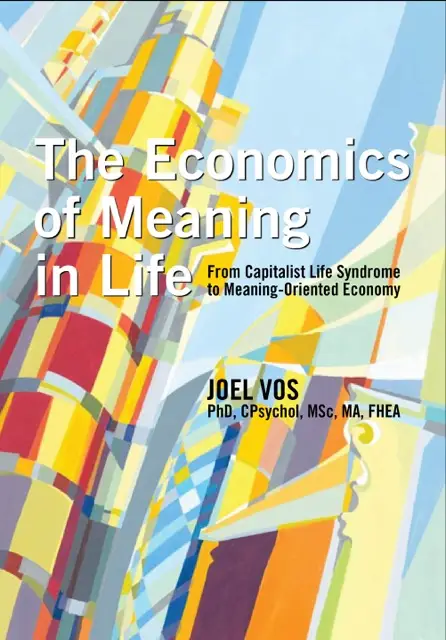
Where can we learn more about "The Economics of Meaning in Life"?
Which videos and podcasts help to learn more?